
Book early
Selecting Your Wedding Officiant
Book your wedding officiant early! Having been an officiant at many weddings in the past, it is perplexing to me that this part of the planning is often an afterthought. Many parts of a wedding are essential. The wedding officiant is one of them.
But there are many things that you need to take into account before selecting the person who will officiate at your wedding. The following highlights a few of those considerations.
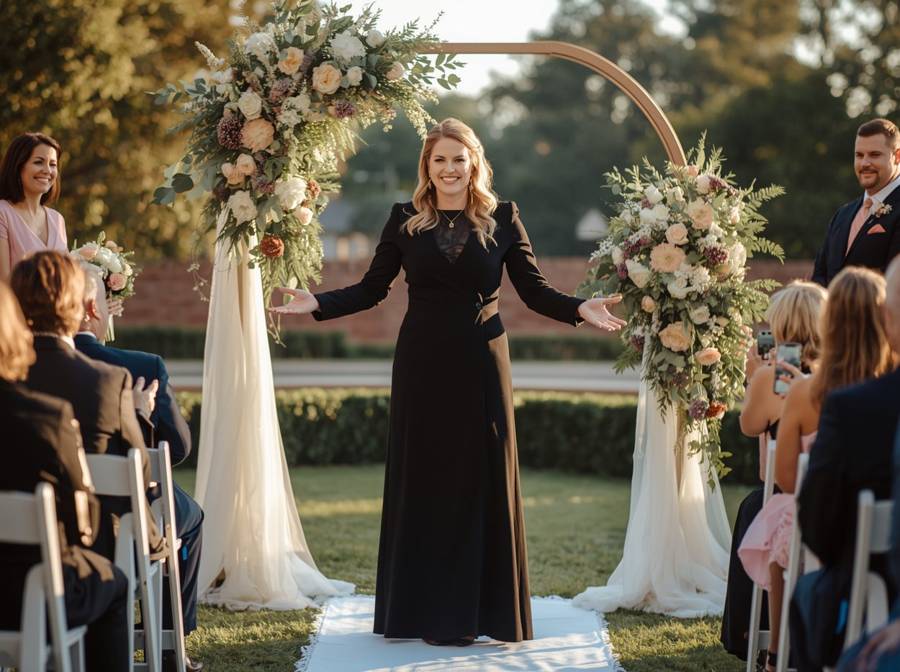
The quick version
- Book your officiant early, at least six months out and preferably about a year ahead.
- Talk with prospective officiants about beliefs and wording, so the ceremony truly reflects you.
- Check who can legally officiate where you’re marrying, since rules vary by state and even county.
- A simple local legal ceremony can make a destination wedding much easier.
- If you’re the chosen one, practice, visit the venue and dress to complement the wedding party.
In this guide
- When and how to select your wedding officiant
- Your wedding officiant and the content of your wedding ceremony
- Is your officiant supportive of what you want to be said at your wedding?
- A way to start the conversation with your officiant
- Who can officiate at your wedding
- Choose your wedding officiant without the legal hassles
- Does it matter how the officiant is dressed?
- Wedding officiant tips if you are the chosen one
When and how to select your wedding officiant
Interviewing and selecting your wedding officiant should take place at least 6 months prior to your wedding date, and preferably about a year in advance. Your...
Tap to read
In this guide
- When and how to select your wedding officiant
- Your wedding officiant and the content of your wedding ceremony
- Is your officiant supportive of what you want to be said at your wedding?
- A way to start the conversation with your officiant
- Who can officiate at your wedding
- Choose your wedding officiant without the legal hassles
- Does it matter how the officiant is dressed?
- Wedding officiant tips if you are the chosen one
Interviewing and selecting your wedding officiant should take place at least 6 months prior to your wedding date, and preferably about a year in advance. Your prospective officiant may have vacations that are booked, family and work commitments, or may be unavailable for any number of reasons.
Talk to your prospective officiants early to ensure your preferred choice is available.
Having to select someone other than your first choice could be a major disappointment. This person sets the tone for your wedding ceremony.
When you have decided who you want to officiate at your wedding you do not want scheduling issues to disrupt your plans that could impact your wedding date and venue. Selecting your officiant early will avoid this.
Who you choose to officiate at your wedding may determine the content and words that are spoken during the ceremony. Refer to the next important section. In that section are many critical considerations to take into account when selecting your wedding officiant.
Not sure where to start? See how to find a wedding officiant: where to look and what to ask before you book.
This person sets the tone for your wedding ceremony.
Your wedding officiant and the content of your wedding ceremony
I would hope that you, the married couple, would be the designer of the ceremony. Within ourweddingguide.com you will see the various parts of the actual wedding...
Tap to read
I would hope that you, the married couple, would be the designer of the ceremony. Within ourweddingguide.com you will see the various parts of the actual wedding ceremony. You will also see several options for each section. You should have a choice in what is spoken during the ceremony.
Construct the ceremony to reflect you. The suggested selections are just that, suggestions. You will have more, and better ideas of what to include. The content within this resource is intended to give you a few ideas and to stimulate your creativity.
Some clergy, and those authorized by the state, will have specific criteria that need to be included in the wedding ceremony. Some will have exclusive or prescribed wording. Some will have exclusions about who they are authorized to marry.
Some faith groups will not automatically marry a couple if one or both have been divorced from a previous marriage. Some will not marry same-sex couples. Some will require that both parties be of the same faith, meaning that if one is from one faith and the other from another faith, it could be the expectation for one to convert.
There could be other stipulations as well such as determining and promising to raise children according to a specific faith. Some faith traditions will allow wedding ceremonies to be conducted outside of the traditional gathering space such as a church or synagogue. Some will not allow alternative venues.
For all of these reasons, talk to prospective wedding officiants early in the process. You need to determine if your faith and values align closely enough with your officiant to have the ceremony reflect YOU. If there is a vast difference in your beliefs and values with those of the officiant, this will bring disharmony to the day and cause at least a measure of discomfort.
I encourage you to review the section entitled Creating the Wedding Ceremony and Its Parts. Review each section of the wedding ceremony. The ceremony is organized in the order in which the elements of the ceremony take place. Determine if the suggested wording is in keeping with how you wish your love and relationship to be expressed. Then share this information with your wedding officiant to determine if you and your proposed officiant are aligned.
Construct the ceremony to reflect you.
Is your officiant supportive of what you want to be said at your wedding?
Each of the following is a component of the wedding ceremony. Each component is presented in sequential order and mirrors how the ceremony will flow. The purpose of this...
Tap to read
Each of the following is a component of the wedding ceremony. Each component is presented in sequential order and mirrors how the ceremony will flow. The purpose of this section is to help you ensure that you and your prospective wedding officiant will be aligned in what you want said during the ceremony.
Click on each section to explore options for creating your ceremony.
- The Processional
- Welcoming your guests
- Inclusion opportunities for the guests
- Readings, poetry, holy writings such as scripture and quotes
- The opening reflection, prayer or acknowledgment of the occasion
- The Charge or the Vision of Marriage (The Message)
- Presenting the bride, groom, or couple
- The Intentions
- Preface to the Vows
- The Vows
- The Blessing
- Preface to the Exchange of Tokens
- Exchange of Tokens
- The Pronouncement
- The Benediction
- The Recessional
A way to start the conversation with your officiant
If you want to be sure you and your officiant are aligned, put your thoughts on paper first. The Wedding Ceremony Words Workbook walks you through your ceremony voice...
Tap to read
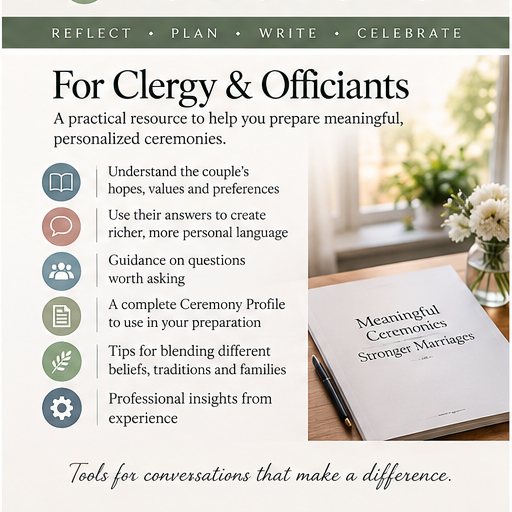
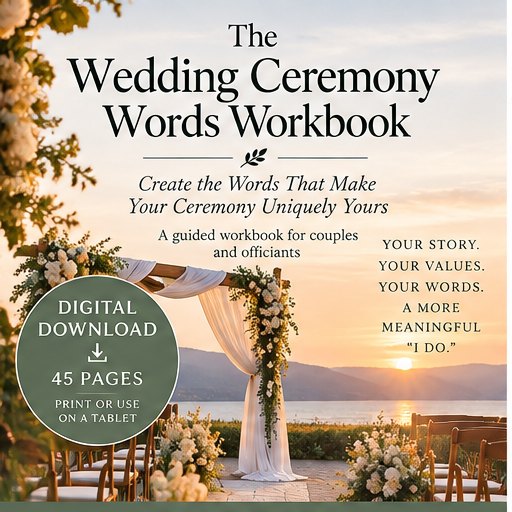
If you want to be sure you and your officiant are aligned, put your thoughts on paper first. The Wedding Ceremony Words Workbook walks you through your ceremony voice, your story, the charge, your vows and more, and it ends with a Ceremony Profile you can hand to your officiant.
Printable workbook
The Wedding Ceremony Words Workbook
A 45-page guide that turns your story, values, vows and ideas into meaningful ceremony language, with a Ceremony Profile you can share with your officiant.
See it on EtsyAffiliate link: we may earn a small commission at no extra cost to you.
Who can officiate at your wedding
Things have changed over the years and now no one needs clergy or a justice of the peace to legally marry a couple. A friend or family member can get authorization to...
Tap to read
Things have changed over the years and now no one needs clergy or a justice of the peace to legally marry a couple. A friend or family member can get authorization to perform marriage ceremonies.
There are different rules and regulations about who can conduct legal wedding ceremonies. These vary from country to country, state to state, and even from county to county. I cannot stress enough that you need to do your research to determine who can officiate at your wedding depending on the location of the ceremony, where you obtain your marriage license, and the type of marriage license that may be available to you.
Decide if your wedding is going to be a religious ceremony, a civil ceremony, or simply a gathering of friends and family. This will help determine who is officiating.
The following are examples of who might serve as your wedding officiant, and a few rules, regulations, and considerations. Doing your research is key. There are too many variables to describe every situation. The following are examples.
The officiant is also part of the paperwork. See the marriage license and certificate for what to bring and what happens after the ceremony.
Officiants of religious wedding ceremonies
If the ceremony is religious, you are probably already connected with the most appropriate person to perform the ceremony. Talk with your pastor, rabbi, or faith leader early. She or he will have information and requirements of which you will need to be aware.
While it might be a delicate question, it is important to determine if the clergy you are using is licensed to conduct wedding ceremonies.
Today there are many faith groups, some mainstream and some lesser known.
In some states, it is the ordination or investment by the recognized denomination or faith group that gives each clergy member the authority to perform a legally binding marriage ceremony.
Not all clergy, however, are registered to perform weddings.
I learned this the hard way at my very first wedding. Read my story: Are you sure you're allowed to marry them?
Wedding officiants who are family or friends
Each state and country will have its own requirements about who can perform a wedding that is considered legal. In some way that person must be certified and authorized to conduct the ceremony otherwise it is just a ritual, and while wonderful and memorable, it holds no legal status.
There are resources available on the web that stipulate who can conduct a legal wedding ceremony for each state within the U.S. It will be important for you to research such resources.
The following information is provided only as examples. Requirements change, and the rules are different from state to state and country to country. Sometimes the rules are different from county to county.
Depending on the state, there are a few ways to have a friend or family member officiate at your wedding. Every state is different and not all of the following apply to any particular state. You must research the rules and requirements for each state to be sure your wedding officiant is legally authorized to perform your wedding ceremony.
Some of the ways of being a legally authorized wedding officiant are to be an ordained minister who has registered and is authorized to perform weddings, being authorized by a county or state office to perform a one-time wedding ceremony, or by holding a state authorized government office position such as a judge, magistrate or justice of the peace.
Keep in mind again, that not all government officials are authorized in all states. Do your research.
In some places, a county office can appoint a friend or family member as a temporary or deputy marriage commissioner for a single ceremony, sometimes only on a license issued by that county. Ask the clerk in the county where you are getting married whether this is available and what it requires.
Self-uniting marriage licenses
A few states offer what is called a self-uniting marriage license. Whether one is available where you are getting married, and what it requires, differs by state and sometimes by county, and rules change, so ask the county clerk.
If a self-uniting license is available, request it when you apply for your marriage license.
This means that it is the couple that makes the marriage legal and not the person performing the ceremony.
Among other things, there may be a requirement for witnesses. In some counties and states, you still need to be a member of a specific faith to obtain the self-uniting marriage license.
This type of license may cost more than a traditional license. The only difference is that instead of having a spot for the officiant to sign and make it official in the eyes of the county, there are lines for witnesses. It is the signature of the witnesses that makes the marriage under the self-uniting marriage license legal. Upon the signature of the witnesses, ta-da, you are married. No officiant authorization is needed. The number of witnesses may also vary from state to state.
Officiants at destination weddings outside the United States
Your venue will have something to do with who will be the officiant at your wedding. Some venues may offer choices, and some may be completely open for you to select whomever you wish.
Some venues will have country-specific requirements. If your wedding is taking place outside of the United States, it is even more important to determine who can be the officiant at your wedding for it to be legal in the United States or in the country in which you live. States may have the right to refuse to recognize marriages performed in another state or country.
Venues in different countries, perhaps at a resort, will have local resources. All of the rules will be different. For example, can a friend officiate my wedding in Mexico? Yes, but you will not be legally married, even if your friend is an ordained minister, priest, rabbi, etc. Only marriages performed by Civil Registry Officials (not religious officials) are considered legal and valid in Mexico.
Choose your wedding officiant without the legal hassles
When you explore the requirements of having your wedding at a particular destination outside of the United States, you may want to consider another option.
Tap to read
When you explore the requirements of having your wedding at a particular destination outside of the United States, you may want to consider another option.
Having a simple ceremony conducted locally by a legally authorized wedding officiant can greatly simplify your dream destination wedding.
This local event can be a very simple and private ceremony. No fussing about anything, just a simple ceremony performed by a local legal official.
Get the license and make the appointment.
Choosing a simple, local, legal ceremony will enable you to have a more elaborate ceremony that does not necessitate following rules and submitting complicated paperwork that may be required for out-of-state, and certainly for out-of-country weddings.
Make your wedding legal locally, and have your dream wedding wherever you choose.
I have officiated at both legal wedding ceremonies and wedding celebrations that were held after the private, legal ceremony. In each of these cases, only the bride and groom, and the most immediate members of the wedding party were aware.
Everything looked and felt the same. Every aspect of the wedding was identical to a wedding performed by a legally authorized officiant. The only difference was that there was no need for legal paperwork. No license and no registering of the event with government agencies were needed. It was just a lovely celebration.
It is still a secret held by the couples themselves. These couples celebrate their wedding anniversary on the day of the larger celebration, not on the day that their marriage was legally binding. You may choose differently and want to be more open about having two ceremonies. Either way is fine.
Make your wedding legal locally, and have your dream wedding wherever you choose.
Does it matter how the officiant is dressed?
Have you wondered what your officiant will wear? It may be of little concern to you, or it may be important that everyone and everything is coordinated. Depending on the...
Tap to read
Have you wondered what your officiant will wear? It may be of little concern to you, or it may be important that everyone and everything is coordinated. Depending on the type of wedding you have, and the officiant that you choose, the design, look, and feel of the entire event will vary.
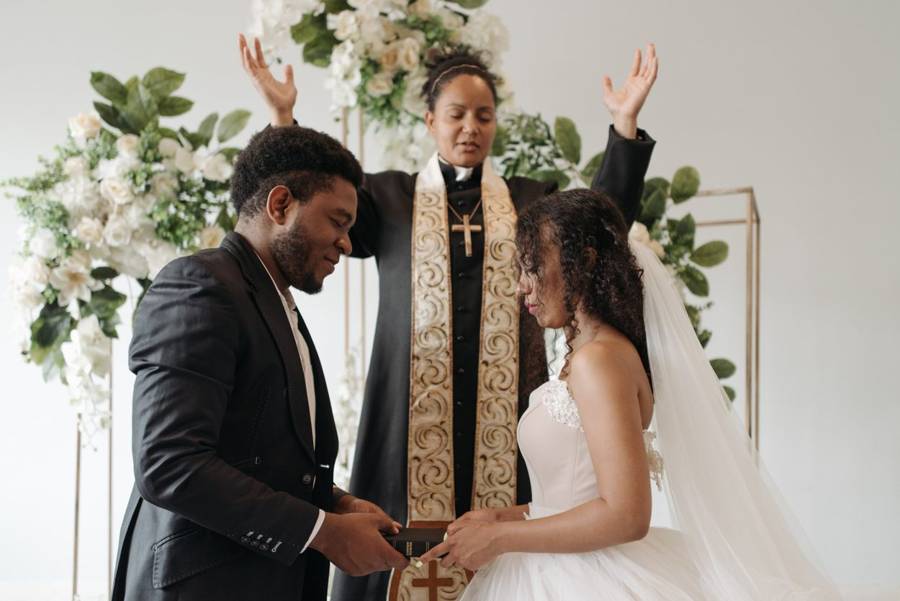
If your officiant is clergy, his or her attire may be predetermined and you will have little say in the matter. This too can vary, however, depending on tradition and your particular faith affiliation.
In the Christian tradition, the dress may include a clerical collar, robes, stoles, or other vestments.
An ordinary suit, conservative dress, or pant ensemble may be appropriate for many faith traditions. Other cultures may have very festive and beautiful garments that are worn at such rituals and celebrations.
In the Jewish tradition the prayer shawl, or tallit, is a garment that signifies reverence and communication with God. A wedding ceremony is considered one of the most sacred rituals in Judaism.
If you choose a friend or family member as your officiant, you can determine the dress code so that the attire is complementary to the event. You may want the officiant to stand apart or complement the wedding party.
You have the distinct honor of joining two people’s lives together marking the creation of family.
Wedding officiant tips if you are the chosen one
If you are the one chosen to officiate at the wedding you have a most special place of honor. All eyes will be on you until of course, the bride enters. After that, the...
Tap to read
If you are the one chosen to officiate at the wedding you have a most special place of honor. All eyes will be on you until of course, the bride enters. After that, the focus goes back to you. You have the distinct honor of joining two people’s lives together marking the creation of family.
Printable guide for officiants
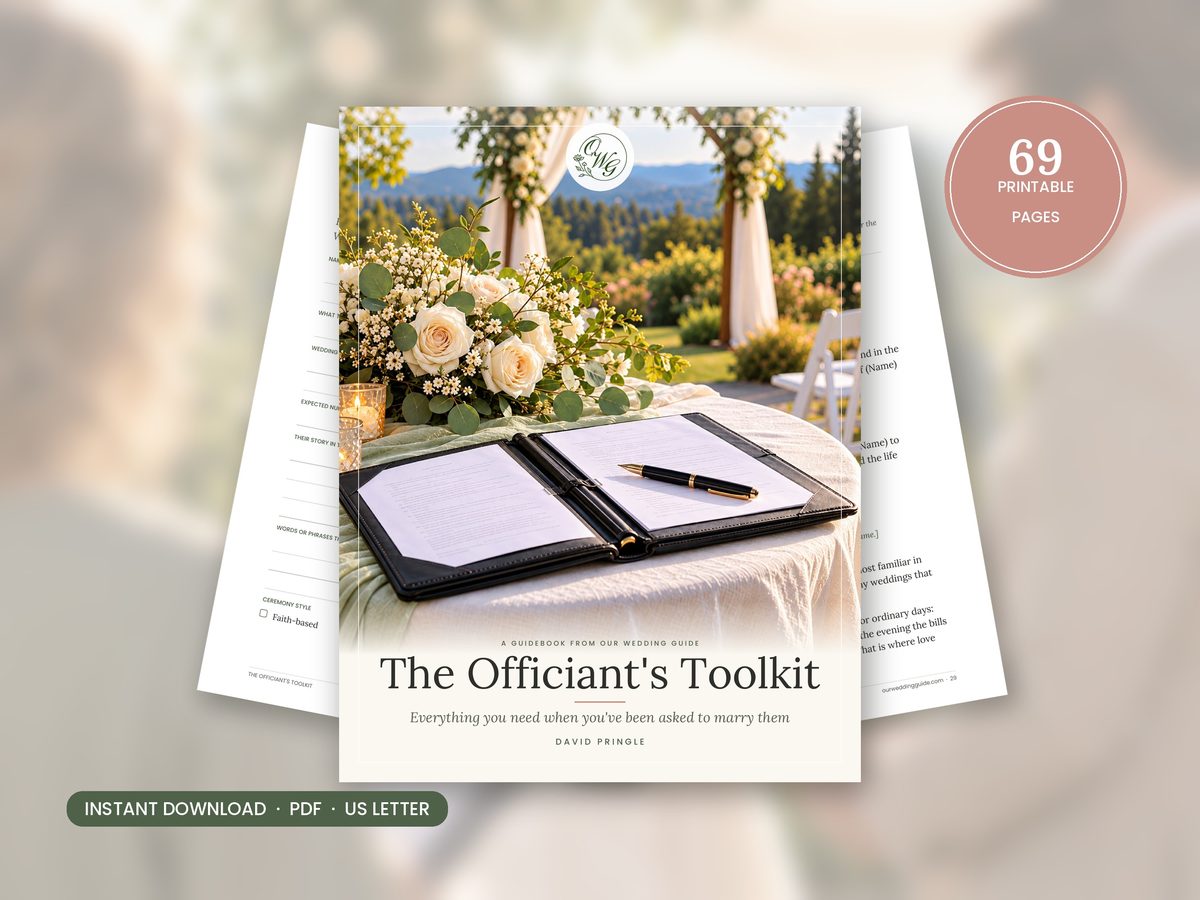
The Officiant's Toolkit
If you've been asked to officiate, this 69-page printable guide walks you through it in order: the legal side, meeting the couple, a ceremony builder, three complete scripts, where everyone stands, the rehearsal, the day, and my own stories of what went sideways.
See what's inside Get it on EtsyAffiliate link: we may earn a small commission at no extra cost to you.
As the officiant, you are responsible for how the wedding ceremony unfolds on the spot. It does not matter if you are clergy, a state or country official, a family member, or a friend. The following still applies.
Five important things to consider
1. Practice, practice, practice and practice
Do not assume that all you have to do is read the content. Even though you may have facilitated and been a key partner in choosing the words for the ceremony, do not assume the words will flow easily.
Being in front of people, being absorbed in the energy of the moment, and having the stimuli of beautiful and complex surroundings, all take your focus.
Read over the content of the entire ceremony several times a day in the months and weeks prior to the ceremony. Rehearse, rehearse, rehearse!
Know the content by heart. Concentrate on the meaning of the words each time you say them.
By doing this, when the time comes, you will be able to maintain eye contact with those getting married, and with those gathered. What you say will be authentic, powerful, and captivating. It will be memorable. Your script will only be a support, and you will not need to depend on the paper in front of you.
2. Know your environment: visit the venue if possible
If at all possible, visit the venue ahead of time. This will make you comfortable with the environment, and give you an idea of where everyone will stand, and where guests will sit.
It will help you know when, and with whom to maintain eye contact. During your visit visualize the flow of the ceremony. From where will the groom enter? Where will the musicians be staged? Will there be a raised platform or dais? All of this will help you own the moment of leadership for which you are responsible.
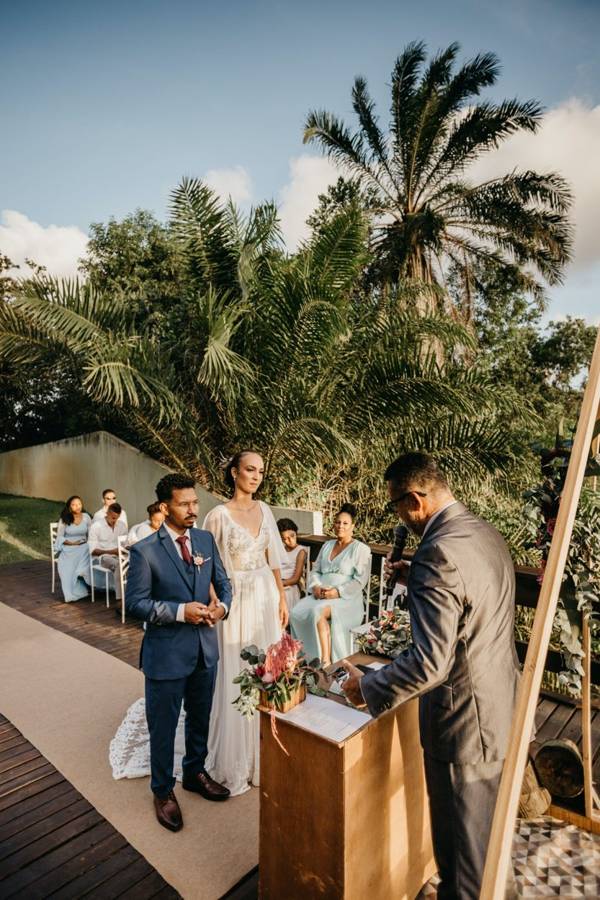
Visualizing and knowing the size of the crowd as well as the depth and width of the room is critical.
The size of the room and the number of guests will dictate how you project your voice, and gauge the span of your vision to create the feeling of inclusion.
Refrain from assuming because you have a microphone that you do not need to speak up. Speak slowly, clearly, and with good energy, not too soft and not too loud. Speaking too loud or too soft will destroy your message.
How you deliver the message will determine if the words are heard, or if they drift into the void.
3. Ask questions
It will be important for you to know how many guests will be attending, and what will be the signal for the minister, groom, and groomsmen to enter. Will you speak with the assistance of a microphone and will it be a lavalier/lapel mic or a fixed mic?
While typically there would not be a podium, you might want to check to be sure. It is highly preferable not to use a podium as this will separate you from the couple and from the guests. Keep the path of communication and space between you and those gathered open. It creates a warm and inviting environment.
Your notes should be in a black or appropriately colored folder.
Be sure the pages of your notes are numbered, and sufficiently secured should you drop them. Sometimes a gust of wind can come up at an outdoor venue. You want to be sure you are not chasing your notes across the open spaces.
4. You are ON!
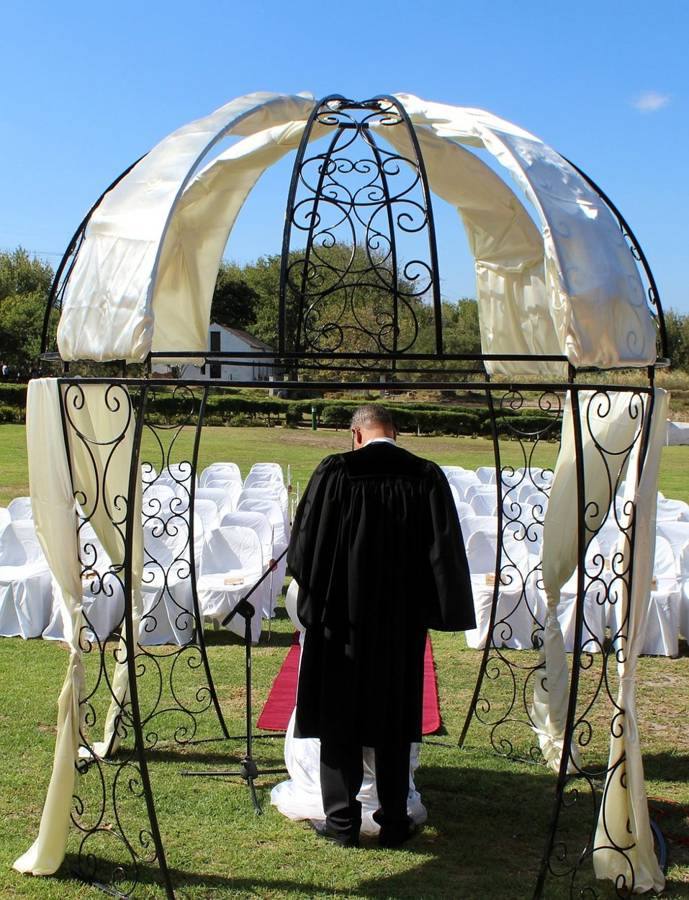
As the officiant, you are front and center, the focal point of the gathering space.
As such you will be in every photograph, in every mobile phone video clip, and in every recorded and memory recollection of the event.
Because of that, you need to always look pleasant, never distracted, always alert, and completely engaged.
You are the master of the event and it does depend on you.
5. What to wear, what to wear?
Regarding what to wear, be sure to talk with the couple to understand what they have in mind. Weddings can vary from very formal to completely casual. Find out if the event is black tie, because if it is, your best options will be a floor-length gown and tuxedo. If it is an evening wedding, but less formal, a beautiful pant ensemble, mid-length or below-the-knee cocktail dress, or suit and tie are good choices.
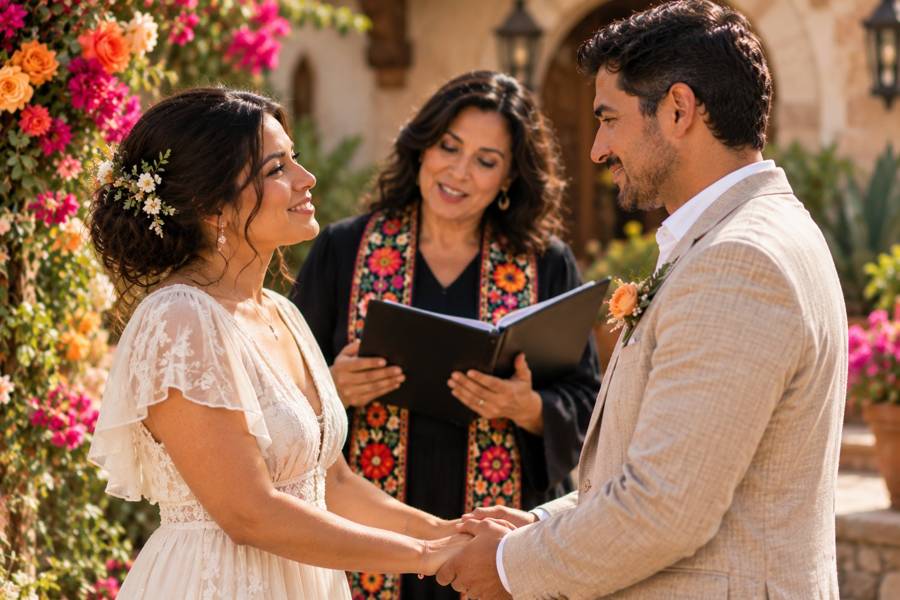
It matters if the wedding is in a religious setting, hotel, outdoors, or on the beach. Sandals on your feet might work well on the beach but not so much for other settings. Sharp-looking heels are elegant but they are not going to work well at an outdoor wedding. Choose footwear appropriate and practical for the setting but still looks great. There is nothing wrong with traditional shoes with flat heels. Sneakers or tennis shoes would be a no; not even on the beach. It goes without saying, even though I am saying it, do not wear socks with sandals.
Color choices should be influenced by the wedding color scheme, time of day, and season. As the officiant, you want to complement, not duplicate what the wedding party is wearing. This goes for the color of your outfit as well.
Muted, lighter tones are good for summer, and especially functional for outdoor weddings. You should not wear bright clear colors as these will stand out and have a high potential to conflict and draw attention away from the wedding party. You are already front and center. You do not need bright colors to enhance your role.
My preference would be light grays for any summer wedding location or light beige tones for beach or tropical locations.
A very subtle print is ok, but it would be best to use it with caution and be conservative. Minimalism is best.
Do not strive to look like you are part of the wedding party. That is not who you are at this event. You have a very different and unique role. You are special in a different way.