🎁 A free gift for newlyweds: Your First Year of Marriage, 12 monthly notes. No email, no strings.Get your free copy
Begin the ceremony
Wedding Processional Order: Who Walks When
The wedding processional marks the official beginning of your ceremony. It is when your wedding party is introduced, important family members are honored, and the tone for everything that follows is set.
As the music begins and each person walks down the aisle, the room changes. Anticipation turns into presence. Everyone gathered shares the same joy and quiet well wishes for the two of you.
This is one of the most meaningful moments of your wedding day. The focus settles gently on you, not as two individuals, but as a couple getting ready to enter into marriage. The processional is more than an entrance. It is the opening movement of your ceremony, and it sets the pace and the meaning for what comes next.
The processional order at a glance
Here is the traditional order most ceremonies start from. Change it to suit you.
Grandparents (optional)
The groom's parents, then the bride's mother
The officiant and the groom, often from the side, with the best man
Most ceremonies follow a general order. Knowing it gives you a good foundation, whether you follow tradition or adapt it to your own style.
Before the music starts: seating the honored guests
In many weddings, the grandparents and parents are seated by ushers just before the processional rather than walking in as part of it. Either way is fine. One old custom is still worth knowing: the mother of the bride is the last person seated. When she sits down, the ceremony has begun. After that, no one else is seated until the processional is over. Late guests wait at the back.
Who walks first?
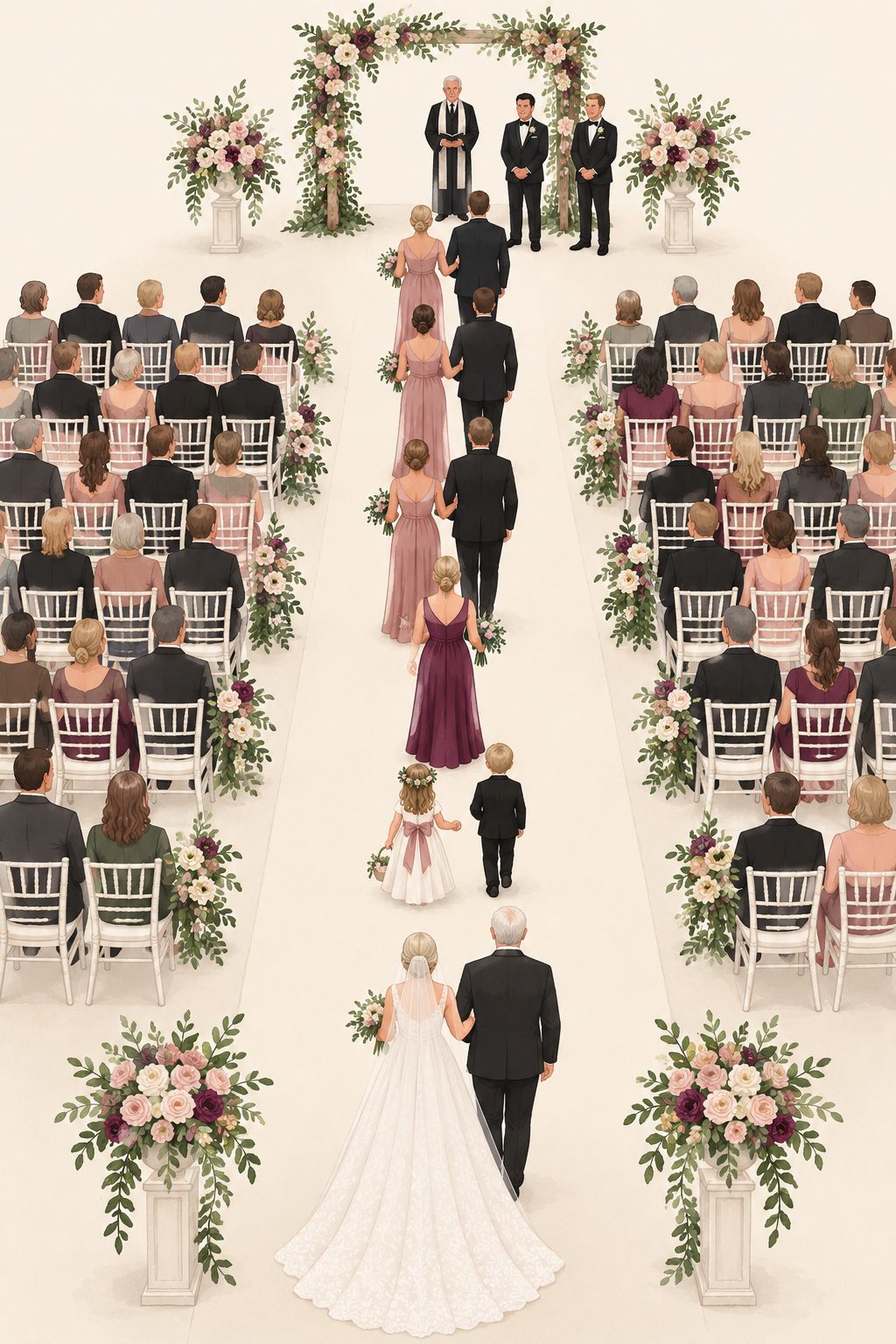
In a traditional processional, the entrance begins with the grandparents (if included), then the parents, the officiant, and the groom. The wedding party follows, and the bride traditionally walks last. The order builds anticipation and leads everyone toward the moment the couple comes together at the front.
The traditional wedding processional order
This sequence has been used for generations. The exact order can vary with religious, cultural, or personal preferences, but this is a common starting point:
Grandparents (optional)
They are honored first, and their presence adds warmth. The groom's grandparents usually go first, then the bride's.
Parents of the groom
Followed by the mother of the bride, who is seated last.
Officiant
Often already at the front, or coming in from the side.
Groom and best man
The groom often enters from the side or is already at the front.
Groomsmen and bridesmaids
Singly, or in pairs who split at the front.
Maid or matron of honor
She leads the way for the flower girls and ring bearers.
Flower girls and ring bearers
Delightful, and sometimes unpredictable.
The bride
Escorted by one or both parents, or entering on her own.
The numbers show the order people walk in. Number 1 goes first, and the bride comes last. Change it to suit you.
Where everyone stands at the front
Walking in is only half of it. Everyone also needs to know where to stop. In a traditional Christian ceremony, as the guests look toward the front, the bride stands on the left and the groom on the right, facing the officiant. The bride's family sits on the left side of the aisle and the groom's on the right. (Jewish ceremonies usually reverse the sides.)
The maid of honor stands closest to the bride and the best man closest to the groom, with the other attendants fanning out beside them in a gentle angle so the guests can still see the couple. Young flower girls and ring bearers usually go sit with their parents once they reach the front. Asking a four-year-old to stand still for twenty minutes is asking a lot.
A traditional Christian layout, seen from above. MOH is the maid or matron of honor. Jewish ceremonies usually reverse the sides.
Processional order for every kind of wedding
The standard order was written for a church wedding with a bride, a groom and a full wedding party. Many weddings don't look like that. Here is a side-by-side look, with a little more on each below.
Kind of wedding
Usual processional order
Church (Protestant)
Grandparents, parents, officiant and groom, attendants, maid of honor, flower girl and ring bearer, bride with escort
Catholic
Either the priest meets the couple at the door and leads the procession, or the priest waits at the altar and the traditional order follows. Ask the parish.
Jewish
Rabbi or cantor, grandparents, groomsmen, best man, groom with both parents, bridesmaids, maid of honor, flower girl and ring bearer, bride with both parents
Civil ceremony or courthouse
Often no processional at all. At a venue, a short version: officiant, attendants, then the couple
Small or backyard wedding
Family seated, officiant takes their place, the couple comes forward, together or one at a time
Second marriage or blended family
Children walk in or escort a parent, or the couple walks in together
No wedding party
Parents and grandparents seated, officiant in place, then the couple enters
Church wedding processional
This is the traditional order shown above, and most Protestant churches follow it or something close to it. Some pastors enter with the groom from a side door. Others are waiting at the front before the music begins. Your pastor or the church's wedding coordinator will tell you their custom. Ask early, because some churches have firm rules about music and movement, and you don't want to learn them at the rehearsal.
Catholic wedding processional
The Catholic Church's marriage rite gives two forms for the entrance. In one, the priest greets the couple at the door of the church and the whole procession comes in together, with the ministers first, then the priest, then the wedding party and the couple. In the other, the priest waits at the altar and greets the couple there, and the procession comes in much like the traditional order above. Some Catholic couples now walk in together, which the rite allows. Every parish has its own customs, so start with your priest or the parish wedding coordinator.
Jewish wedding processional
A Jewish processional honors both families in a lovely way. Both parents walk with each of their children. A common order is the rabbi or cantor, then the grandparents, the groomsmen and best man, the groom with his parents, then the bridesmaids, the maid of honor, the flower girl and ring bearer, and the bride with her parents. The parents often stand under the chuppah with the couple. Practice varies a great deal from one community to the next, so let your rabbi guide you.
Civil ceremony processional
At a courthouse or a Justice of the Peace's office, there is no processional. A processional would certainly be out of place there. You walk in together and stand before the officiant. If you are having a civil ceremony at a venue, though, you can have any processional you like, from the full traditional order to the two of you walking in together.
Small wedding processional
With twenty guests in a backyard, you may not need a processional at all. Seat the family, let the officiant take their place, and then the couple comes forward. The officiant can begin like this:
"Would you all please rise as (Name) and (Name) come forward to be married."
What matters is that the start of the ceremony feels deliberate, not that a lot of people walk. A small wedding can still have a beautiful entrance.
Second marriage and blended family processional
For a second marriage, many couples walk in together. You have both lived some life, and coming down the aisle side by side says you arrive as partners. If there are children, this is a wonderful place to include them. A son or daughter can walk a parent down the aisle. The children can come in just ahead of the couple, or stand with you at the front. Older children can serve as attendants. Be sensitive to how the children feel about it. Include them, but don't push them into a role they aren't ready for.
More couples are skipping the wedding party. That's fine. Seat the parents and grandparents before the music begins, let the officiant take their place, and then the couple enters, together or one at a time.
Who walks the bride (or the groom) down the aisle?
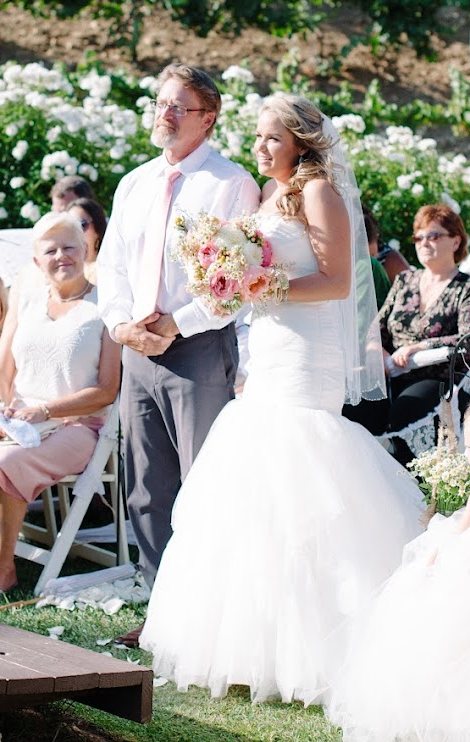
Traditionally the bride's father walks her down the aisle. That is still the most common choice, and it is a tender moment. But there are many other good choices, and none of them needs an explanation:
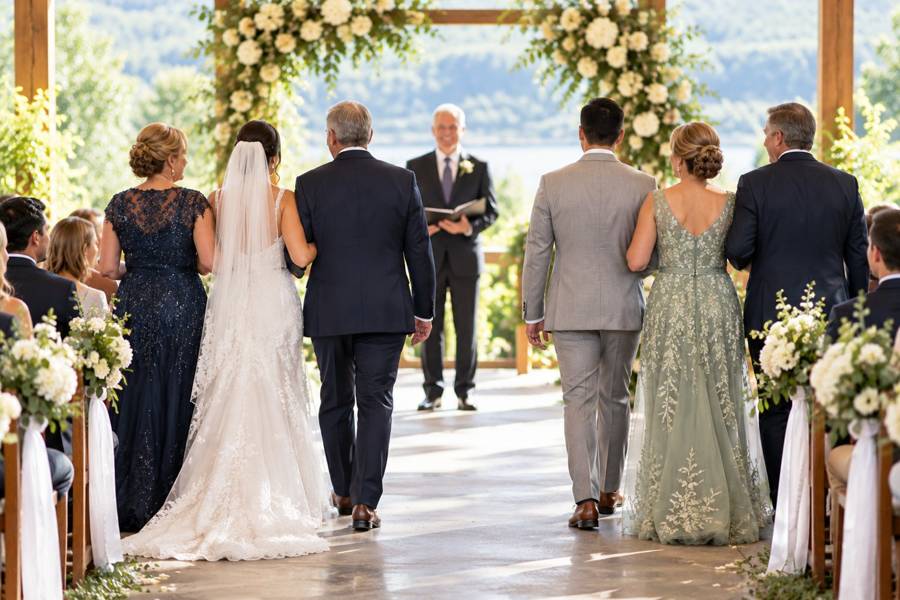
Both parents. One on each side. It honors the mother as much as the father, and it is the custom at Jewish weddings.
Her mother. Especially when her mother raised her.
A stepparent, or a parent and a stepparent. Some brides walk halfway with one and the rest of the way with the other.
A grandparent, brother, sister, uncle or dear friend. Choose the person who has stood by you.
Her son or daughter. A lovely choice for a second marriage.
On her own. Walking alone has its own statement of elegance and purpose.
And the groom can be escorted too, by his mother, by both parents, or by his children.
When parents are divorced
This one takes some care. The goal is that no one feels pushed aside on your wedding day. Talk with each parent privately, well ahead of time, rather than surprising anyone at the rehearsal. Seat each parent in the front row with their own partner if they have remarried, or seat one parent in the second row if the front row would be uncomfortable. If walking with one parent would hurt the other, walking with both, or on your own, can be the gracious answer.
When a parent has died
Some couples leave an empty chair in the front row, or place a flower or photograph there. Some carry a small keepsake. Some ask a grandparent or uncle to walk with them. Whatever you choose, it doesn't need to be explained to the guests. Those who loved that parent will understand.
Traditional vs. modern processional
A traditional processional follows a structured sequence. The groom waits at the front and the bride enters last. That builds anticipation and emphasizes the bride's entrance.
A modern processional is more flexible. You might walk in together, give each partner a distinct entrance, or adjust the order for family circumstances, cultural traditions, and your own values. In simple terms:
Traditional: structured order, groom waits at the front, bride enters last
Modern: flexible order, shared or separate entrances, personalized roles
Watching your partner walk toward you is one of the most memorable experiences of the ceremony. For some, protecting that moment is essential. For others, showing equality and shared presence matters more. Either is fine. What counts is that your processional reflects your story and sets the tone for the ceremony you are about to share.
Meaning within tradition
Tradition is a good structure, but ask what feels right for you, your partner, and your guests.
I have seen processionals to the tunes of rap, hip hop, and dance themes. For me, these types of entrances detract from the dignity and significance of the moment. The processional does not need to be stuffy, but it holds a different feel than the reception or the after party. It is the opening of the ceremony, and it sets the tone for everything after.
A meaningful entrance for both partners
I have a bias toward giving the groom his own moment. Typically the groom enters from the side and waits at the front. Brides should not be the only ones with special significance. It takes two to make a marriage. Why not find a way to mark his entrance? That might mean:
Walking down the aisle with his parents
Having a clearly defined moment of arrival
Being more visible at the start of the processional
There is also a great deal of memory making in watching the one you are about to marry walk down the aisle, so be sure that creativity does not sacrifice meaning.
It takes two to make a marriage. Why not find a way to mark his entrance?
Other ways to line up the wedding party
Each of you escorted in
Some couples want each of you to have your own walk, escorted by a parent or someone special. One simple pattern: the wedding party first, then (Name) with a parent, then (Name) with a parent, meeting at the front. It's a lovely way to honor both families.
Walking in together
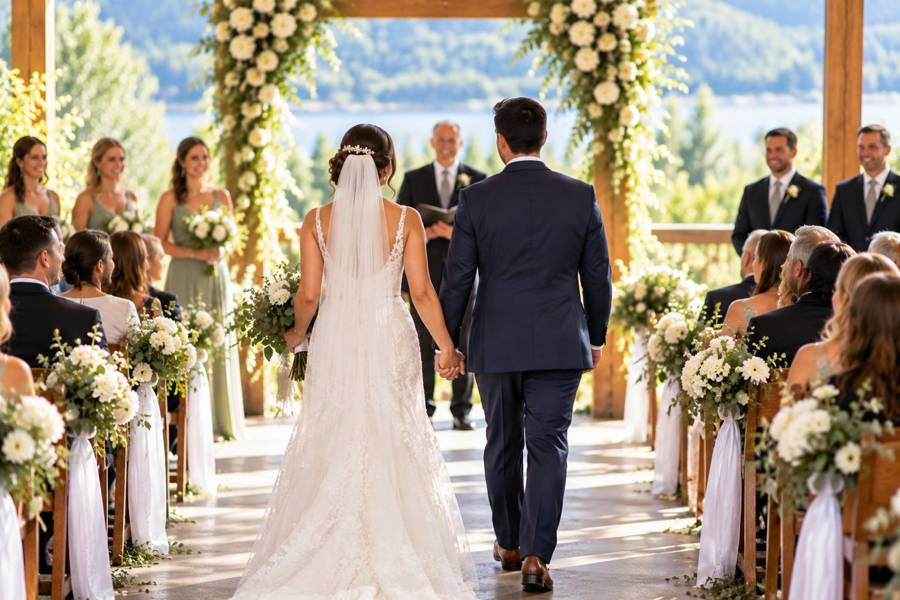
The two of you come down the aisle side by side, after the wedding party or on your own. It says "we arrive as partners," and it takes away a lot of nerves.
Bridesmaids and groomsmen: singly or in pairs?
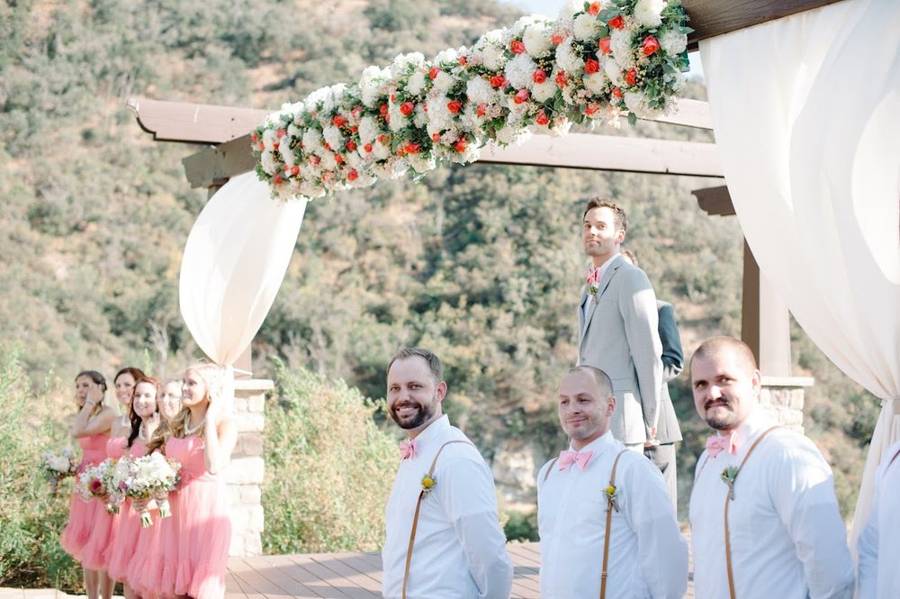
It has always been typical to put the guys on one side and the girls on the other. The groom's friends line up by him, the bride's friends line up by her, and they march in boy, girl, boy, girl. That's fine if it's the look you want. It's traditional, and it photographs neatly.
But friendships today are a lot more mixed than they used to be. The bride's best friend may be a man. The groom's oldest friend may be a woman. A few ways to do it:
Stand by friendship. Each person stands on the side of the partner they're closest to. A "groomswoman" or a "man of honor" is perfectly normal now.
Pair people who belong together. Pair a brother and sister, two old roommates, a couple who are married themselves, or two friends from each side who should meet.
Walk in pairs, then split. Pairs come down the aisle together and part at the front, each going to their own side. It looks lovely and keeps the aisle moving.
Groomsmen already at the front. If the aisle is long or the wedding party is big, the groomsmen can come in from the side with the groom, and only the bridesmaids walk the aisle. It cuts the processional time nearly in half.
Uneven numbers are fine. If one side has more people, let someone walk alone, or have three walk together. Nobody in the pews is counting.
Don't match by height. Pair people by who they are, not how tall they are.
Still choosing your attendants? See the wedding party for who does what.
Spacing, pace and timing
A processional that flows well doesn't happen by accident. A few simple guidelines make all the difference:
Spacing. Start each person or pair when the one ahead is about halfway down the aisle. Too close, and it looks like a parade. Too far apart, and the music runs out.
Pace. Walk slowly and naturally, a little slower than you think you should. The old "step, together, step, together" hesitation step has mostly gone, and good riddance. Just walk.
Length. For a wedding party of average size, the processional usually takes three to five minutes.
The pause. Before the bride enters, let the music change or pause for a moment, and let the doors close and open again if you can. That little gap tells everyone what is coming.
When guests stand. Traditionally the mother of the bride stands when the bride appears, and the guests follow her lead. Or the officiant can simply invite everyone to rise.
Eyes up. Tell your wedding party to look up and smile, not at their feet. The photographs will thank you.
Wedding processional music
Music shapes the atmosphere of your processional. It is often the first emotional signal your guests receive, so it sets the tone for the whole ceremony.
Many couples choose traditional selections, and others prefer music that reflects their personality. There is no single right choice, but there should be clear intention behind it.
Timing and transitions
Will one piece play from beginning to end?
Will there be a transition before the bride or couple enters?
Will the tempo match the pace of each person walking?
Some couples shift the music just before the final entrance, to mark that the moment has come and the bride is about to enter. Truly, here comes the bride! It creates a quiet but powerful moment of anticipation. Talk it over with your musicians or DJ.
Communicate your music choices
The most common trouble with processional music is miscommunication. I learned that at the rehearsal for a wedding I was part of.
When it came time for the bride to walk in, the organist didn't play "Here Comes the Bride." She played something else entirely. The bride stopped and asked why. The organist told her the traditional piece wasn't included in the music package, so she had put in a substitute.
You can imagine how that felt to a bride on the edge of her wedding day. It got worked out. After some conversation, the organist agreed to put the traditional march back in. But all that upset could have been spared by one early, thorough conversation about the music.
The lesson is simple: be sure your music selections are clear, in writing, well before the ceremony. And ask what the music package actually includes.
"Here Comes the Bride" or the Wedding March?
People mix these two up all the time, so it's worth knowing which is which when you talk to your musician.
"Here Comes the Bride" is really the Bridal Chorus by Richard Wagner. It's stately and slow, and it's played as the bride comes in.
The Wedding March by Felix Mendelssohn is the bright, ringing piece usually played as the newly married couple goes out.
Other favorites for the processional include Pachelbel's Canon in D, Jeremiah Clarke's Trumpet Voluntary, Bach's Air on the G String and Jesu, Joy of Man's Desiring, and Handel's Arrival of the Queen of Sheba.
One more reason to ask early: some churches don't allow the Bridal Chorus at all. Better to find that out months ahead than at the rehearsal.
Musical interpretation
Even when the right piece is chosen, how it is played can vary a lot. One musician may play it soft and gentle. Another may make it celebratory or dramatic. Either can be wonderful, but make sure the style matches what you want. If you can, hear how your musician or DJ will present the music before the rehearsal.
What goes wrong, and how to handle it
Most processionals go beautifully. But after many weddings, I can tell you the same few things tend to go sideways. Nearly all of them are easy to prevent.
The ring bearer won't walk
Little ones freeze. It happens.
Read more
Seat a parent at the end of a row near the front, where the child can see them, and have them walk toward that parent. If the child plants their feet, let it go. A parent can scoop them up, or an older child can take their hand. Guests always smile at this. Never force it. And give the ring bearer a pillow with ring replicas tied on. The real rings stay with the best man or maid of honor.
Someone walks in empty-handed
Bouquets and boutonnieres go missing in the rush.
Read more
I grew up in my parents' flower shop, where weddings were my mom's specialty, and I sometimes made the deliveries. Flowers are part of the processional too. Name one person to hand out the bouquets and pin on the boutonnieres before anyone lines up, so nobody is hunting for flowers as the music starts.
The music runs out, or runs too long
The bride isn't at the front and the song is over.
Read more
Ask your musician to watch the aisle, not the clock. A live musician can repeat a section or bring it to a graceful close when the bride reaches the front. If you are using recorded music, make sure the person running it knows to fade out gently rather than stop dead or let the next song start.
Everyone rushes
Nerves make people walk fast.
Read more
Practice the spacing at the rehearsal, and put a calm person at the back to send each pair off at the right moment. A wedding coordinator, a trusted aunt, or an usher can do it. A gentle "go" and a smile is all it takes.
Late guests wander in during the processional
Someone always arrives just as the bride does.
Read more
Ask the ushers to hold late guests at the back until the bride has reached the front, then seat them quietly at the side. No one should walk the aisle ahead of the bride.
Trips and tangles
Long dresses, trains, aisle runners and uneven grass.
Read more
Walk the actual aisle at the rehearsal in the shoes you'll wear, if you can. Outdoors, check for soft ground and uneven spots. Aisle runners can bunch up or slip, so ask the venue how theirs is fastened down. And the escort should walk on the side away from the train.
No one knows where to stand
The wedding party arrives in a clump.
Read more
At the rehearsal, show each person exactly where they stop. In some venues a small, discreet mark on the floor helps. The first person in should go to the far end of the line, so the line fills in toward the couple.
The first words after the processional
Once everyone is in place, the officiant's first words carry the moment forward. I always memorized the first words I would speak to the guests.
At one wedding, the wedding party wanted to face the guests. So I stood off to the side as everyone gathered. When they were all in place, I turned and spoke to the guests, strongly but warmly and sincerely.
Afterward, guests told me how "on" I was. I think it was because those first words created a sense of expectancy and told them why they were there. Not everyone is invited to a wedding. They were the chosen few.
Walk the processional at least twice at the rehearsal: once slowly, so everyone learns their order and where to stand, and once with the music, so the timing feels natural. Have the person who will send everyone off at the back do the same job at the rehearsal. And show everyone how they will leave again, because the recessional is usually the processional in reverse.
Your processional is more than a sequence. It is an experience. When it is planned with care, it becomes a meaningful introduction to your ceremony and something you will remember for years.
Questions couples ask
Who walks first in a wedding processional?
In a traditional processional, grandparents walk first, then the parents, then the wedding party. The officiant and groom are usually already at the front, and the bride comes last. Many couples change the order, and that's fine.
Who walks first, the bridesmaids or the groomsmen?
If they walk separately, the groomsmen usually come in first (or enter from the side with the groom), followed by the bridesmaids, then the maid of honor. Many couples simply pair them and let each pair split at the front.
When is the mother of the bride seated?
Traditionally she is the last person seated before the processional begins. Once she sits down, the ceremony has begun, and no one else is seated until the bride reaches the front.
Does the groom walk down the aisle?
Traditionally he enters from the side and waits at the front. But he can walk in with his parents, or on his own, and I'm in favor of giving him a moment of his own. It takes two to make a marriage.
What is the processional order for a second marriage?
There is no set rule. Many couples walk in together. If there are children, they can walk in just ahead of the couple, escort a parent down the aisle, or stand with the couple at the front.
What is the processional order with no wedding party?
Seat the parents and grandparents before the music starts, let the officiant take their place, and then the couple enters, together or one at a time.
What is the Jewish wedding processional order?
A common order is the rabbi or cantor, grandparents, groomsmen, best man, the groom with both parents, bridesmaids, maid of honor, flower girl and ring bearer, and the bride with both parents. Practice varies, so let your rabbi guide you.
Who walks the bride down the aisle if her father can't?
Anyone who has stood by her: her mother, both parents, a stepparent, a grandparent, a brother or sister, her son or daughter, or a dear friend. She can also walk on her own.
What side does the bride stand on?
In a traditional Christian ceremony, the bride stands on the left as the guests look toward the front, and the groom on the right. Jewish ceremonies usually reverse the sides.
What song is "Here Comes the Bride"?
It's the Bridal Chorus by Richard Wagner, and it's played as the bride comes in. Mendelssohn's Wedding March is the bright, joyful piece usually played on the way out. Some churches don't allow the Bridal Chorus, so ask early.
How long does the processional take?
Usually three to five minutes for a wedding party of average size. Start each person when the one ahead is about halfway down the aisle. Your musician can stretch or shorten the music to fit.
Can we walk down the aisle together?
Yes. Walking in together says you arrive as partners, and many couples love it. It works especially well for a second marriage or a small wedding with no wedding party.