
From ceremony to celebration
Wedding Recessional: Order, Ideas & How to End the Ceremony
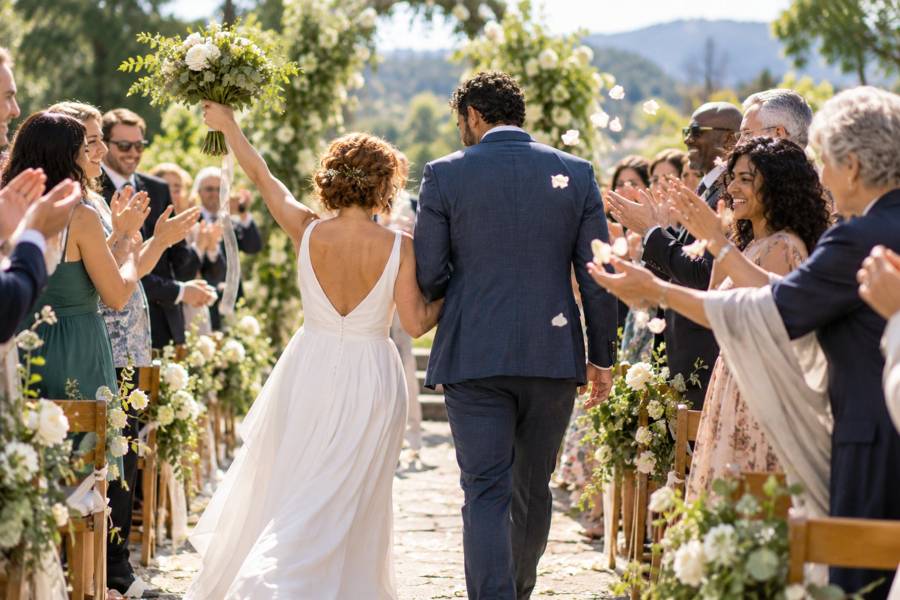
The wedding recessional is the way the newly married couple, wedding party and, eventually, the guests leave the ceremony space after the ceremony has concluded.
It may seem like a small detail, and often very little attention is given to it. But the recessional is one of the most celebratory moments of the wedding ceremony. The ending of one event is the beginning of the next. The recessional is the transition from the meaning and significance of the ceremony to the celebration that follows.
In a very real sense, the recessional marks the first steps the couple takes together into married life.
That is one reason I believe some thought should be given to the order of the recessional. Those closest to the newlyweds often follow closest behind them: family members, attendants and others who have stood with them during the ceremony. There is something wonderfully symbolic about that. The couple moves forward together, accompanied by the people who will continue to love and support them in the years ahead.
Of course, the recessional also has a practical purpose. A little planning helps everyone know when to move, where to go and what happens next. Instead of an awkward ending or a rush for the door, the ceremony can flow naturally into whatever comes next. Do not leave this to chance. If the recessional is clumsy and does not flow smoothly, it will take the focus away from the moment.
The quick version
- The recessional is the transition from the ceremony to the celebration, and the couple’s first steps into married life.
- Do not leave it to chance, because a clumsy exit takes the focus away from the moment.
- A joyful walk is wonderful. A race to the exit is not, especially in formal shoes and long dresses.
- Say very little before it, and only tell guests what they need to know next.
- Practice it at the rehearsal. One good run-through is usually enough.
In this guide
- Five things to consider
- What signals that the recessional is about to begin?
- What is the wedding recessional order?
- The recessional may be different for every wedding
- Choosing your wedding recessional music
- What should the officiant say before the recessional?
- Help your guests know what happens next
- How can guests participate in the recessional celebration?
- Practice the recessional at your wedding rehearsal
- From ceremony to celebration
Five things to consider
Before deciding exactly how your wedding recessional will work, think through these five questions:
- What will signal that the recessional is about to begin?
- What will be the order of the recessional?
- What music will be played during the recessional?
- What happens immediately afterward, and how will your guests know what to do?
- Will your guests participate in the celebration as you leave?
None of these decisions needs to be complicated. But thinking about them ahead of time can make the conclusion of your ceremony feel natural, joyful and well planned.
What signals that the recessional is about to begin?
The vows have been spoken, the rings or other tokens have been exchanged, and the couple has been pronounced married. A benediction, blessing or other closing words may follow.
And then comes the moment everyone recognizes: the recessional begins.
Usually the first notes of the recessional music, or another planned sound or cue, provide the signal. The newly married couple turns and begins walking back up the aisle, followed by the wedding party.
The change in music and movement should make the transition unmistakable. The formal ceremony has concluded, and the celebration has begun.
The recessional usually moves at a somewhat quicker and more relaxed pace than the processional, but don’t get carried away.
Remember that members of the wedding party may be wearing unfamiliar formal shoes, long dresses or clothing that restricts movement. They may also be carrying flowers or other items. A joyful walk is wonderful. A race to the exit is not. Taking a tumble at the end of the ceremony would be a most unfortunate conclusion, and it would pull attention away from the beautiful finish of the ceremony.
The goal is to allow the energy of the ceremony to build naturally into a celebratory conclusion.
What is the wedding recessional order?
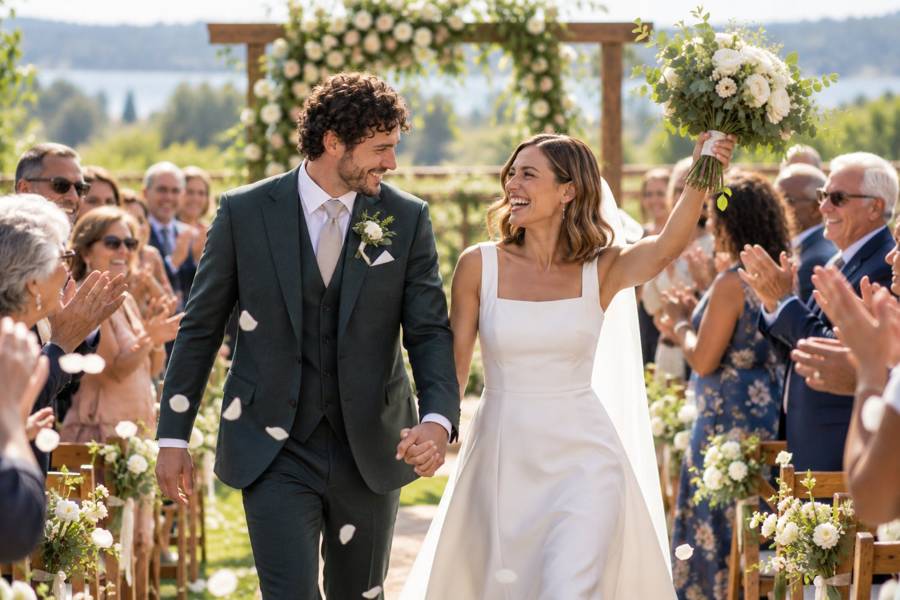
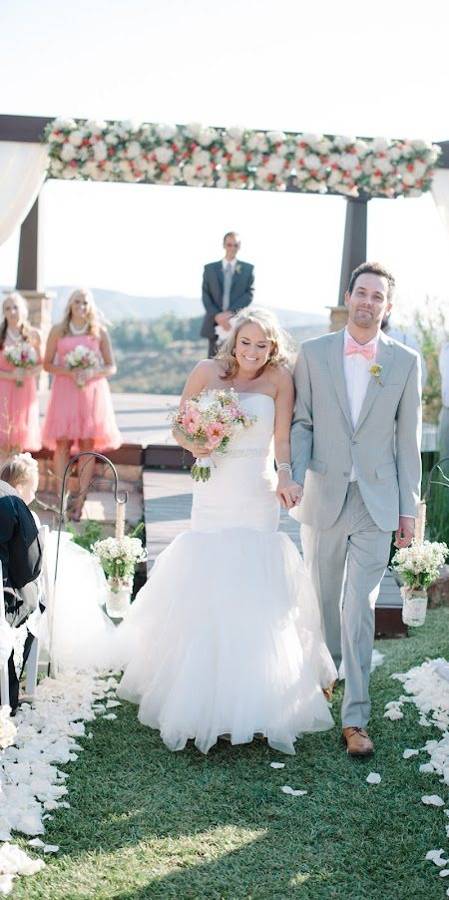
There is no single recessional order that every wedding must follow. Traditionally, however, the newly married couple exits first, followed by those who participated in the wedding ceremony. In many weddings, the recessional is essentially the reverse, or mirror image, of the processional.
One possible traditional order might look something like this:
- The newly married couple
- Flower child and ring bearer (consider if this is best)
- Maid or matron of honor and best man
- Other attendants, usually exiting in pairs
- Parents of the couple
- Grandparents
- Guests, beginning with the rows closest to the front
This is only a starting point.
Today’s wedding parties take many forms. Flower girls do not have to be girls, and ring bearers do not have to be boys. A bride may have male attendants. A groom may have female attendants. There is room for creativity here. You might combine these roles, or have a junior attendant carry a sign that says, “Here comes the bride!” Some couples have several attendants; others have none at all.
The titles of the roles matter much less than the relationships behind them.
Choose the people who are meaningful to you, and arrange the recessional in a way that makes sense for your wedding.
There is also no need to become overly concerned about maintaining perfect order once the wedding party has left. Guests generally understand that the rows nearest the front leave first and the others follow. People are courteous when leaving an aircraft, and guests at a wedding are even more so. Since the seating honors the parents and grandparents, each row will almost naturally follow without instruction. Things tend to fall apart in outdoor settings, but that usually happens long after the couple has made their exit and is nothing to worry about.
Most importantly, you want everyone to enjoy the moment rather than feel bound by unnecessary protocol.
The recessional may be different for every wedding
The setting of your wedding can make a difference in how the recessional works.
In a church, chapel, synagogue, temple or other house of worship, there may be established customs about how the wedding party exits and when guests are dismissed. Ask your officiant or venue representative whether there are traditions or requirements you should know about.
At an indoor secular venue, there may be more flexibility. The couple and wedding party can usually leave in whatever order works best, with guests following afterward.
An outdoor wedding often feels more informal. There may be several ways for guests to leave rather than one center aisle, and people may naturally begin talking and mingling as soon as the couple has exited. That is perfectly all right.
For a small or intimate wedding, an elaborate recessional may not be necessary at all. The couple may simply walk out together while family and friends follow.
And if there is no formal wedding party, the recessional can be wonderfully simple: the newly married couple leaves together, followed by parents, family members and guests.
The purpose isn’t to follow a particular formula. It is to create an ending that fits the wedding you have planned.
Choosing your wedding recessional music
Music can do something words cannot: it can immediately tell everyone that the mood has changed.
For centuries, fanfares, bells, trumpets and other sounds have announced moments of importance and celebration. A wedding recessional carries something of that same spirit. At a horse race, a bugler signals that the jockeys and horses are to proceed to the track. Trumpeters announce the entrance of royalty. Even the stock market opens each day with the ringing of a bell. So it is exciting and appropriate that some signal of sound announce that two have become one and a new life together has begun. Two people have just made promises to one another, and now it is time to celebrate.
Recessional music is usually brighter, stronger or more upbeat than the music used for the processional.
Traditional choices include Mendelssohn’s “Wedding March” and Beethoven’s “Ode to Joy.” But there is no requirement that you choose traditional wedding music.
You might choose classical music, a favorite contemporary song, a string ensemble, piano, organ, trumpets, bagpipes or even bells. The important thing is that the music reflects the feeling you want at that moment.
I confess to a personal preference here. If I had the opportunity to hear Mendelssohn played on a magnificent pipe organ or by a powerful orchestra, I would be tempted to choose it. But that’s my preference. You will have your own.
Choose music that sounds like your celebration.
And here’s another possibility: bells.
Instead of recorded or instrumental music, several people could walk ahead of the couple ringing handbells as the recessional begins. It can create a wonderful sound of celebration, and gives a whole new meaning to having “ring bearers.”
What should the officiant say before the recessional?
Ideally, very little needs to be said immediately before the recessional.
The final moments of a wedding ceremony should be allowed to build toward their natural conclusion. Announcements made right before the recessional are anti-climactic and spoil the anticipation of the moment.
If guests need instructions, I prefer giving them before the final benediction, blessing or closing words whenever possible.
The announcement should include only what guests actually need to know. For example:
Reception or cocktail hour
“Following the ceremony, everyone is invited to join the couple for cocktails and refreshments in the garden. Please remain seated while the wedding party recesses, and then make your way to the garden.”
Photographs before the reception
“The couple and their families will remain briefly for photographs following the ceremony. Guests are invited to make their way to the reception, where refreshments will be waiting.”
Receiving line
“Following the recessional, the couple will greet you just outside the entrance. After greeting them, please continue to the reception area.”
A simple transition
“At the conclusion of the ceremony, please remain seated while the wedding party recesses. You are then invited to join the celebration in the reception hall.”
These announcements don’t need to sound like housekeeping instructions. A sentence or two is usually enough.
Help your guests know what happens next
Over the years, I have found that one of the simplest ways to create a smooth conclusion to a wedding ceremony is to answer the question guests are already asking themselves: What happens next?
They may need to know whether they should remain seated, where the reception is being held, whether refreshments are being served, whether photographs will take place first, or which direction they should go when they leave.
Don’t make your guests figure it out.
A few clear words can prevent confusion and allow everyone to move naturally from the ceremony into the celebration.
There is an important distinction, however: only announce what guests need to know next.
This is not the time for a long list of reminders about the rest of the day. Give them the information they need for the next step and let the celebration continue.
How can guests participate in the recessional celebration?
Guests already participate simply by being there: standing, applauding, smiling and sharing in the excitement as the newly married couple walks back up the aisle.
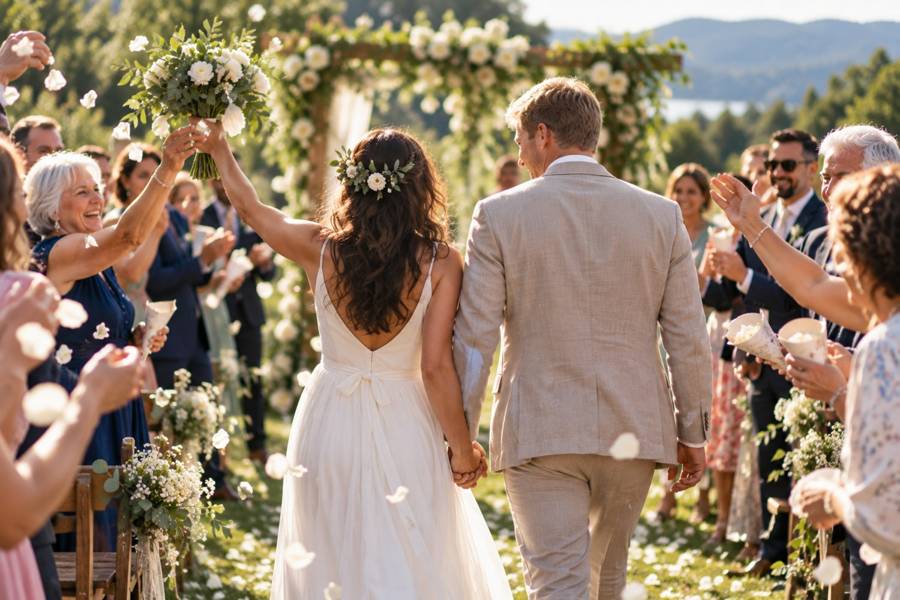
Some couples want something more celebratory: flower petals, confetti, bubbles, bells or another send-off tradition.
But timing matters.
We’ve all seen the movie version in which the newlyweds emerge from the church while everyone is already outside waiting to shower them with rice or confetti. There is one obvious logistical problem: if the guests are sitting inside when the couple recesses, how did they get outside first?
Usually a send-off works better as a separate moment after the ceremony, once guests have had time to gather outside.
Before planning one, check with your venue. Many venues restrict rice, confetti, flower petals or similar materials because of cleanup, safety or environmental concerns.
And bubbles?
I admit I have never been particularly fond of them. They can land on carefully chosen clothing, and everyone is dressed in some of the nicest clothes they own. But that’s my opinion. The choice is yours.
Whatever you choose, think through where the guests will stand, how they will receive whatever they are using, and when the couple will make their exit. A little planning can turn it into a genuinely joyful moment rather than an exercise in crowd control.
Practice the recessional at your wedding rehearsal
The recessional should be practiced during the wedding rehearsal just as the processional is.
Don’t assume everyone will automatically know what to do simply because they are walking out rather than walking in.
Practice who leaves first, who follows whom, whether attendants walk individually or in pairs, where everyone goes after leaving the ceremony space, and when the guests will be dismissed.
It doesn’t need to be rehearsed repeatedly. Usually one good run-through is enough.
It is also a good idea to have your photographer attend the rehearsal. That lets the photographer know where to stand to capture the recessional at its best. It is also a chance to catch those relaxed, lighthearted moments of the rehearsal. Great informal snapshots happen when people are at ease, having fun and enjoying each other’s company.
The goal isn’t perfection. It is confidence.
When everyone knows what is expected, they can stop worrying about where they are supposed to go and simply enjoy the moment.
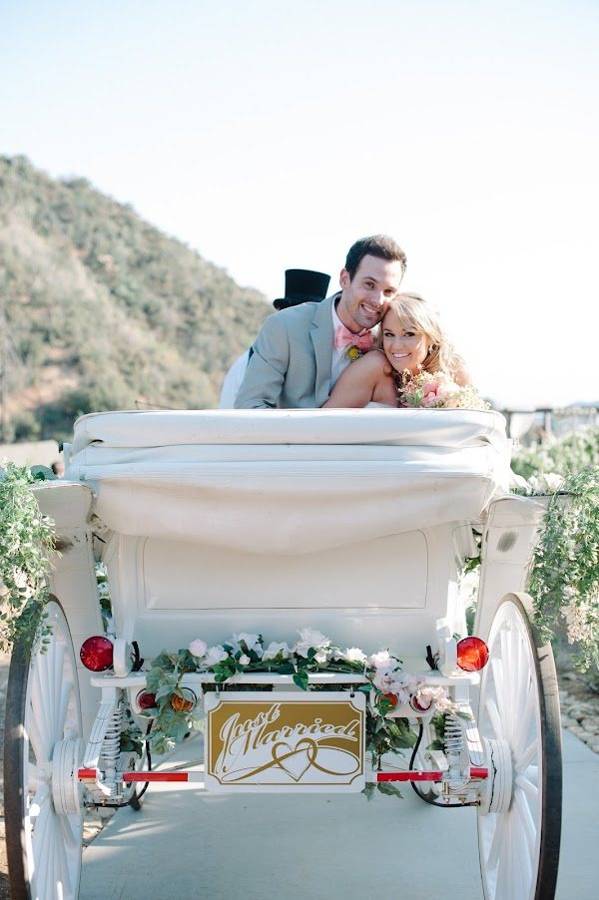
From ceremony to celebration
The recessional lasts only a few minutes, but it carries the wedding across an important threshold.
You entered the ceremony ready to make promises to one another. You leave having made them.
Perhaps that is why I think the recessional deserves a little more attention than it sometimes receives. It isn’t simply the way everyone gets out of the room.
It is the first walk the two of you take together as a married couple.
For help planning how the recessional fits with the vows, ring exchange, pronouncement, benediction and the other parts of your ceremony, see our Complete Wedding Ceremony Script Guide.