Greet your guests
Wedding Welcome Speech Examples for the Ceremony and Reception
There are many ways to say “welcome to our wedding,” and the words you choose do more than greet your guests. They set the tone for your whole ceremony.
Your wedding welcome is the first spoken moment of the day. It connects people, invites your guests into the experience, and reflects the spirit of your relationship.
I officiated a lot of weddings over the years, and I always memorized the first words I would say to the guests. Not the whole ceremony, just the opening. Those first few seconds tell everyone why they are there.
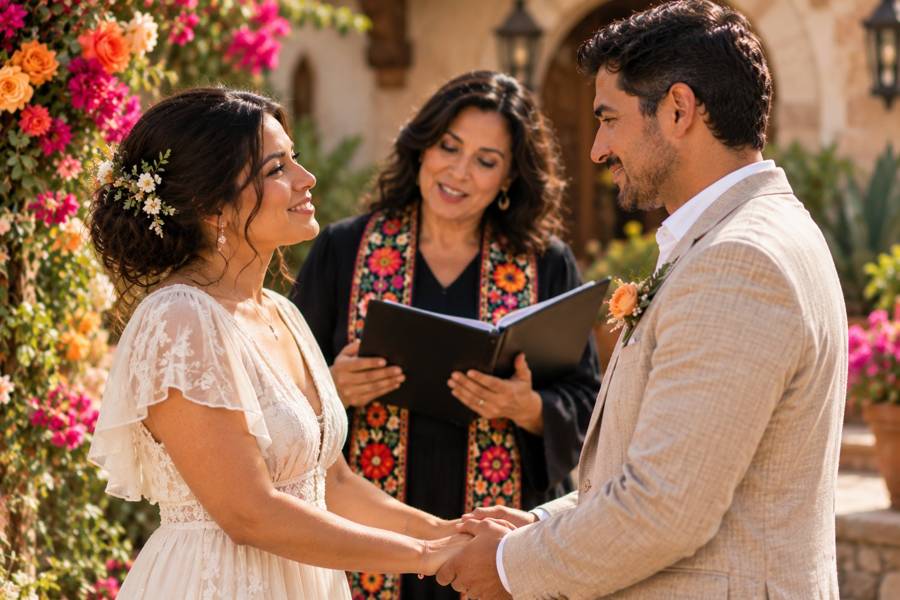
A welcome can come from your officiant, a parent or family member, a close friend, or the two of you together. No matter who speaks, it should feel warm and sincere, and it should fit the meaning you want your ceremony to have.
Below you will find wedding welcome speech examples for the ceremony, and further down, welcome speech examples for the reception. Use them as a starting point. Adapt the wording, combine ideas, and shape them into something that feels natural to you.
If you prefer a more personal approach, you and your partner can greet your guests yourselves with a simple message such as:
“Welcome to our wedding. We are so happy you are here to share this moment with us.”
Your officiant can then continue with a more formal welcome.
To see how your welcome fits into the whole ceremony, read the complete wedding ceremony script guide.
The quick version
- Your welcome sets the tone for your whole ceremony.
- Your officiant, a parent, a friend, or the two of you can give it.
- Memorize the first two or three sentences, look at your guests, and wait for quiet before you start.
- A reception welcome is shorter and lighter: thank people, then tell them what comes next.
- A good welcome has four parts: greeting, thanks to guests, meaning of the day, and a move into the ceremony.
- Use the examples as a starting point, then adapt the wording until it feels natural to you.
- Keep it honest and grateful, and make it sound like you.
In this guide
- Who should welcome guests at a wedding?
- How to structure a wedding welcome speech
- What I learned about the first thirty seconds
- Ceremony welcome speech examples
- Wedding reception welcome speech examples
- Quick answers about wedding welcome speeches
- Ready to build the rest of your ceremony?
- Final thoughts: welcoming your guests with intention
Who should welcome guests at a wedding?
There is no single right person. The choice depends on your style, your relationships, and the tone you want. These are the most common options:
Tap to read
In this guide
- Who should welcome guests at a wedding?
- How to structure a wedding welcome speech
- What I learned about the first thirty seconds
- Ceremony welcome speech examples
- Wedding reception welcome speech examples
- Quick answers about wedding welcome speeches
- Ready to build the rest of your ceremony?
- Final thoughts: welcoming your guests with intention
There is no single right person. The choice depends on your style, your relationships, and the tone you want. These are the most common options:
- Officiant (most traditional and common): The officiant typically opens the ceremony with a polished, structured welcome that sets a formal and meaningful tone.
- The couple (modern and personal): Many couples welcome their guests themselves, together or one at a time, for a more intimate and inclusive feeling.
- A parent or family member (honor and tradition): A heartfelt welcome from a parent or close relative is special when family plays a central role.
- A wedding party member (supportive and familiar): A member of the wedding party can welcome guests as a way to represent your shared friendships and community.
- A close friend (personal and expressive): A trusted friend can give a warm, relaxed message that reflects your personality and story.
Whoever you choose, the goal is the same: to make your guests feel valued, included, and part of something meaningful.
If you have both a ceremony and a reception, you may want two welcomes: one from your officiant to open the ceremony, and a shorter one at the reception from your hosts, your emcee or the two of you. There are reception examples further down.
How to structure a wedding welcome speech
A good welcome does not have to be long, but it should be intentional. A simple structure helps your message flow and set the right tone. Most effective welcomes have...
Tap to read
A good welcome does not have to be long, but it should be intentional. A simple structure helps your message flow and set the right tone. Most effective welcomes have four parts:
Greeting
Open by welcoming everyone and acknowledging that they are here.
Acknowledgment of guests
Recognize the effort guests made to attend, especially those who traveled.
Meaning of the day
Reflect briefly on the significance of the moment and the relationship being celebrated.
Transition into the ceremony
Gently guide guests into what comes next, whether that is readings, vows, or the formal ceremony.
When these come together, your welcome becomes more than an introduction. It is a meaningful beginning to your ceremony.
A good welcome does not have to be long, but it should be intentional.
What I learned about the first thirty seconds
I always memorized the first words I would speak directly to the guests. I could read the rest of the ceremony if I needed to, but not the opening...
Tap to read
I always memorized the first words I would speak directly to the guests. I could read the rest of the ceremony if I needed to, but not the opening. When you look people in the eye at that moment, instead of down at a paper, they settle in and listen.
At one wedding the wedding party wanted to face the guests. So I stood off to the side while everyone gathered. When they were in place, I turned and spoke to the guests directly. I spoke confidently and strongly, but warmly and sincerely.
Afterward, guests told me how “on” I was. What I think they really meant is that the welcome created a sense of expectancy. It told them why they were there. What I said, in one form or another, was this:
“Not everyone is invited to a wedding. You are the chosen few.”
That one line does a lot of work. It thanks people without sounding like a thank-you card. It reminds them they were chosen because they matter to this couple. And it quietly asks them to pay attention, because something important is about to happen.
A few things that help
- Memorize the first two or three sentences. Read the rest if you like. Nobody minds.
- Wait for quiet. Don’t start over the last notes of the processional or the shuffle of people sitting down. A short pause gets attention better than a loud voice.
- Speak to the guests, not the couple. The couple will have your full attention in a minute. The welcome belongs to the people in the seats.
- Say the couple’s names. It makes the welcome theirs and not just a script.
- Keep it short. A minute or two is plenty. The welcome opens the door. It isn’t the whole house.
If you’re a friend or family member who has been asked to officiate, the wedding officiant guide walks through the rest of the ceremony.
Ceremony welcome speech examples
Each of these has a different tone and approach. As you read, think about how your welcome will set the stage for the rest of your ceremony.
Tap to read
Each of these has a different tone and approach. As you read, think about how your welcome will set the stage for the rest of your ceremony.
Personal welcome: the chosen few
Best for an officiant who wants a warm, direct opening that speaks right to the guests.
Good afternoon, and welcome. Before we begin, I want you to notice something. Not everyone is invited to a wedding. You are the chosen few.
(Name) and (Name) looked at all the people in their lives and asked you to be here, because you have mattered to them, and you will matter to them in the years ahead. Some of you came from just down the road and some of you came a long way. Thank you for coming.
In a few minutes you will hear two people make promises to each other. You are not here as an audience. You are here as witnesses, and as the friends and family who will help them keep those promises. So let’s begin.
Traditional welcome: journey theme
We gather today in celebration of (Name) and (Name)’s love for each other. Through this ceremony, we rejoice with them as they are about to embark on an exciting journey. We know that God will be their guide, his presence their light, and his word their compass. Those of us who know the early days of (Name) and (Name)’s relationship, will recall, with them, the preparation that has been made for this voyage: the love that formed the sails, the patience that charted their course, and the gentleness that preserved their vessel. We, who are gathered, bid each of them farewell, and quickly step to the other shore to greet them as sojourners.
Faith-based welcome: celebration and blessing
Best for couples who want a warm, spiritual opening that emphasizes gratitude, celebration, and shared joy.
Today is a day of celebration. As Jordan and Chris have expressed, welcome to our wedding.
Jordan and Chris have made the feast ready and we have been made welcome. The flowers are in bloom, the table spread, the candles lit. Let us rejoice together, for today two hearts are made glad and God’s grace is upon us.
Warm welcome: inclusive and reflective
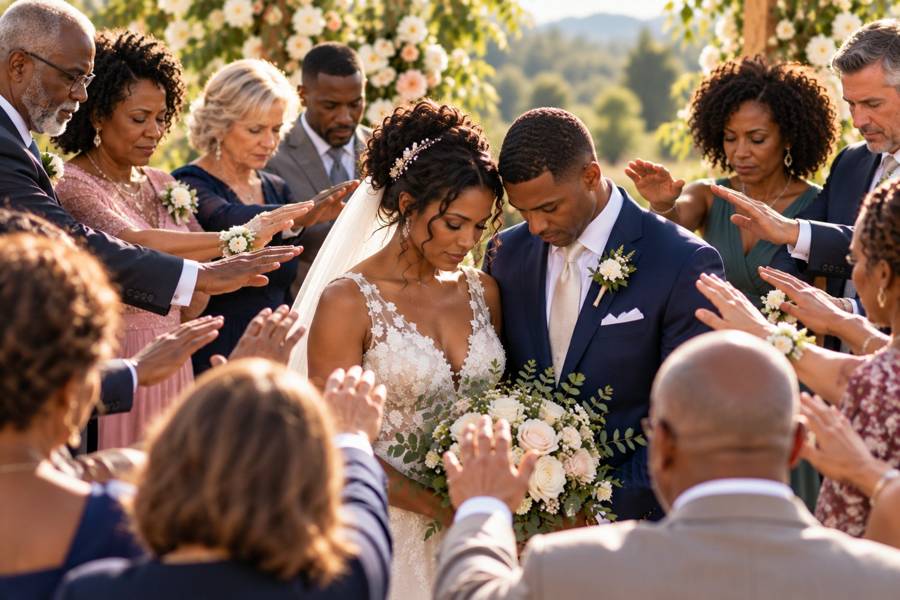
Best for ceremonies that invite guests to join in offering a shared blessing and support.
The love of God is good, and his favor is upon us. The light that shines from the east reminds us of a new day, and the breeze from the south, that there will be creation again. When the western sky tells us that a time of rest has come, love will be our cocoon, and in the chill of the north, the glow of commitment will warm us.
As an expression of the blessing that you would bestow upon this day, would the congregation please respond with the words printed in your bulletin.
Congregational blessing
The couple: Welcome to our wedding!
Leader: (Name) and (Name), we have gathered to accompany you to the gates of your journey.
Congregation: May you enter through these gates with joy, and tread paths of delight.
Leader: (Name) and (Name), we have gathered to rejoice with you.
Congregation: May the voice of your celebration be clear, and resound throughout your life together.
Leader: (Name) and (Name), we have gathered to offer our support.
Congregation: May our prayers go before you, our presence be felt by you, and our help be near.
Formal welcome: sacred union
We have gathered together to celebrate with (Name) and (Name) the marriage into which they are about to enter.
Throughout time, marriage has been recognized as a natural relationship. It has been solemnized by the observances of ritual and by the gathering of family and friends to proclaim their blessings. Women and men of holy designation have consecrated these unions and announced the favor of God.
Marriage, therefore, is to be entered into with deliberation and reverence. The celebration in which we join today, is the outward symbol of an inward relationship, recognized by God, by society, and by law. While it is recognized, it is made real and living only within the lives of those who share it.
We are privileged today because we, who gather here, are celebrants and witnesses to the sacred union that (Name) and (Name) desire to enter.
To the couple:
(Name) and (Name) you have freely decided to commit yourselves to each other.
Your commitment means that you will work together to continue your relationship and, by so doing, intertwine your lives bringing you even closer to each other.
In the presence of these witnesses you will give your word to that commitment, confirming your intention and determination to strengthen and cherish the relationship you are building together.
Formal welcome: covenant of marriage
Today we have come together to witness the covenant of (Name) and (Name) in marriage. This is a state which embodies all the warmth and precious values which grow from love and human companionship.
It changes the lives of two people in a permanent way. It is not, therefore, entered into lightly or carelessly, but wisely, thoughtfully, and in the knowledge that love, and its expressions, are the highest form of human achievement. With this in mind, (Name) and (Name) now come to be recognized as husband and wife.
This celebration is an outward ceremony signifying an inward union of hearts and minds. (Name) and (Name), it is a union which you create through your loving purpose and which you will keep by your enduring fidelity to each other. It is blessed by the congregation and legalized by the state. Neither congregation nor state, however, can truly bring about this union of minds and hearts.
Simple welcome: short and celebratory
Welcome to this day of celebration! It is a day to celebrate love, to celebrate life, and to celebrate the union of these two people before us.
Simple welcome: ceremony opening
We have come together in this place to share the joys and hopes of (Name) and (Name) who will live from now on as husband and wife. They have come here to pledge their vows of marriage, one to the other.
Warm welcome: shared celebration
Dear friends, you and I are privileged to share with (Name) and (Name) in their celebration of one of the most significant and memorable moments of their lives.
The marriage between them is not created by you or by me. (Name) and (Name) create it through the mutual love and commitment that they already share.
Today, in the presence of us all, they will simply put to words, the commitment that has been born out of their love.
It is good that you, who are of special significance to (Name) and (Name), should be present to rejoice with them today. Let us now hear (Name) and (Name) pronounce their vows. Let us listen to their hopes and plans. As we extend our good wishes, may we be reminded of the love and commitments that are part of our own lives.
Supportive welcome: commitment and growth
(Name) and (Name), you have invited us to be with you today as witnesses to the happiness you have found together, and to confirm the pledge which will publicly express your commitment each to the other. We gather with you, indicating that we support the decisions that you have made, and that we will continue to stand by you.
This ceremony, in truth, marks neither a beginning nor an end in your relationship. Rather it is a step in a continuing process of change and growth.
As you go forward together, we pray that your marriage will remain as a source of strength, and that you will gain new insights from each other.
When you make mistakes, when there are times of tension and conflict, we pray that these will be openly acknowledged and faced. Our hope for you is that joy will be yours to share, and that you will find new meaning and richness in your life together.
Poetic welcome: love and wonder
Is the beauty of today in the bride dressed in splendor, or in the sparkle in her eyes?
Is the joy of today in the stature of the groom, or in the passion of his heart?
Is the fragrance of today in the flowers around the room, or in the bouquet the guests comprise?
Is the music of today in the pipes and flutes and strings, or in the symphony created by two in love?
Today is magic, and all that is before us only tokens of that which (Name) and (Name) feel for each other.
May we, who are guests, look with delight upon what is before us and give expressions of gladness that can be mingled with those of (Name) and (Name).
Poetic welcome: the mystery of love
What brings two people together? Can it be discovered by research, study, or observation?
It is a wonderful mystery that cannot be tarnished by tampering. We can ponder how we come to meet that one who, from thousands, becomes precious.
Alas, we cannot create the substance of the jewel. It is from a world that we can enjoy, but not possess, for we are love’s possession.
Therefore, let us rejoice! Today we participate in a miracle. Two people have found each other and love has created a precious gem.
The brilliance of the stone can best be seen by (Name) and (Name), and so it is, through their eyes, that we share these moments today.
Spiritually based welcome: love as a gift
Is the celebration that we are about to enter made possible by a plan or accident of the divine? Out of thousands, have two people just stumbled upon one another?
Whatever you believe to be true makes no difference, for that which is about to take place is only possible because of the capacity that has been placed within us by our Creator.
Love cannot be manufactured, sought out, or insisted upon. It is a gift and can only be given. If it is rejected, the gift has not gone away.
(Name) and (Name) have received that gift from each other and today we are here to bear witness to its fruit. May we celebrate with full hearts the joy of this day and all that is before us.
Personal welcome: guest commitment and support
Welcome! We are happy that you have come to join (Name) and (Name) to celebrate this day. Today marks an entrance, the introduction of a new book, the telling of a new story.
We are not here by accident, or simply because we are family. It is because of the relationship that we have developed with (Name) and (Name). We have given ourselves to them, and now our attachment calls us to express some of what we feel.
By our presence we acknowledge our support for the love that (Name) and (Name) feel, and for the decision that they have made to live together as husband and wife.
As (Name) and (Name) make commitments, so too, we acknowledge our pledge. We commit ourselves to support (Name) and (Name) in their new relationship, to rejoice in their love for each other, to be with them in times of trouble, and to pray for them that they grow together.
As we begin the pleasures of the day, may their union, and our presence, be pleasing in God’s sight. Welcome to our wedding!
Personal welcome: guest appreciation and reflection
To all who have traveled, whether from down the street or across the land, (Name) and (Name) greet you.
Thank you for choosing to arrange your time so that you could share in this day.
(Name) and (Name) hope that you will be able to experience even a small part of the joy that they feel.
As we proceed into the marriage ceremony for (Name) and (Name), may your own relationships become richer as you call to remember those times of special significance in your lives.
Personal welcome: love and lifelong journey
We are here today because we know (Name) and (Name), and want to participate in the celebration of their love for each other.
This is a good thing to do, for we are witnesses to a relationship that will grow and bear fruit.
Together (Name) and (Name) will come to share with each other in all joy, strengthen each other in all adversity, help each other in all toil, hear each other in all pain, and rejoice with each other in all memories.
As they grow old together, life’s joys and sorrows will become golden threads that bind their relationship, forming a unique and priceless tapestry, a treasure beyond the grasp of anyone save (Name) and (Name).
Wedding reception welcome speech examples
The ceremony welcome opens the wedding. A reception welcome opens the party. It usually comes right after the couple’s grand entrance, before the meal...
Tap to read
The ceremony welcome opens the wedding. A reception welcome opens the party. It usually comes right after the couple’s grand entrance, before the meal, and it’s often the first thing anyone says into the microphone.
Traditionally the hosts gave it, which usually meant the bride’s parents. Today it might be both sets of parents, the couple, the emcee or DJ, or a close friend. If someone is saying grace before the meal, the welcome usually comes just before it.
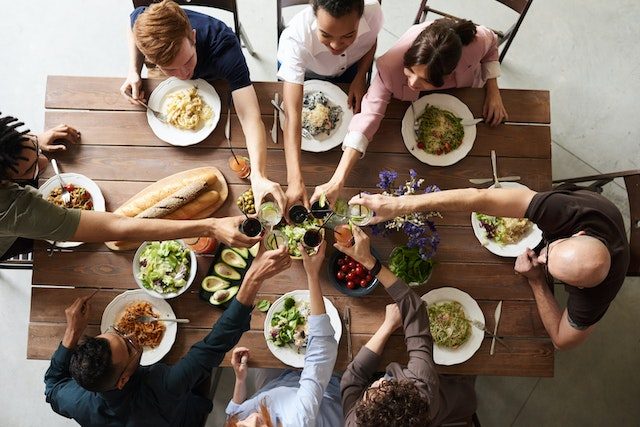
A reception welcome is shorter and lighter than a toast. A minute or two is enough. A good one does four things:
Welcome everyone
Say who you are, and thank people for coming.
Thank the people who helped
Parents, the wedding party, and anyone who traveled a long way.
Remember who is missed
One sentence is enough. You don’t want to bring the room down, just to say they are remembered.
Say what happens next
Dinner, grace, toasts, cake, dancing. Then hand it off, or raise a glass.
If you want to say more about the couple themselves, save it for a toast. Our wedding toasts guide and the father of the bride speech and toast page can help with that.
Reception welcome from the parents (the hosts)
Good evening, everyone. For those who don’t know us, we are (Name)’s parents, and on behalf of both our families, welcome. We are so glad you’re here.
Some of you drove across town, and some of you crossed the country. Every one of you made today better by coming. We especially want to welcome (Name)’s family. As of this afternoon, you’re our family too.
Dinner will be served in just a few minutes. Before that, (Name) will say grace. Later on there will be toasts, cake, and plenty of dancing. So eat well, visit, and enjoy yourselves. Welcome!
Reception welcome from the couple
Hi everyone! We just want to say thank you. Looking out at this room is a little overwhelming. Everyone we love is in one place, and that almost never happens.
Thank you to our parents, who did more for today than any of you will ever know. Thank you to our wedding party for keeping us calm, mostly. And thank you to all of you for coming, especially those who traveled a long way to be here.
There are a few people we wish were here today. We’re thinking of them, and we feel them with us.
Now please eat, drink and dance. We’ll be coming around to every table to see you.
Reception welcome from an emcee or friend
Good evening, and welcome to the reception of (Name) and (Name)! My name is (Name), and I’ve known (Name) since (how you know them). I’m your host tonight, which mostly means I’ll be telling you where to go and when.
A couple of quick things. The guest book is on the table by the door, so please sign it before the night is over. (Name) and (Name) will be visiting each table during dinner. After dinner we’ll have toasts and the cake cutting, and then the dance floor opens.
For now, would you please welcome, one more time, the newlyweds!
A short welcome toast
Best for hosts who want to welcome everyone and raise a glass in under a minute.
If everyone would raise a glass. To the families who raised these two, to the friends who stood by them, and to all of you who came to share this day: welcome, and thank you.
And to (Name) and (Name): may your home always be as full of the people you love as this room is tonight. Cheers!
Planning the rest of the evening? See our wedding reception planning guide.
Quick answers about wedding welcome speeches
How long should it be, how is it different from a toast, and who gives it at the reception...
Tap to read
How long should a wedding welcome speech be?
One to two minutes. At the ceremony that is usually a short paragraph or two. At the reception it can be even shorter. If you find yourself going much past two minutes, you are probably giving a toast.
What is the difference between a welcome speech and a toast?
A welcome speaks to the guests. It thanks them and tells them what is happening. A toast speaks about the couple, usually with a story, and ends with everyone raising a glass. A short welcome toast does a bit of both.
Who gives the welcome speech at a wedding reception?
Whoever is hosting. That used to mean the bride’s parents. Now it might be both families, the couple, or an emcee. If nobody has been asked, ask someone. A reception with no welcome feels like a party where nobody answers the door.
What do you say at the start of a wedding ceremony?
Welcome the guests, say why you are gathered, say the couple’s names, and move into the ceremony. Any of the ceremony examples above will do that, and you can follow with ways of including your guests in the ceremony.
Ready to build the rest of your ceremony?
Your welcome is only the beginning. Explore the Complete Wedding Ceremony Script Guide to see how the welcome flows into readings, the charge, vows, the exchange of rings, the pronouncement, and the closing.
Final thoughts: welcoming your guests with intention
Your wedding welcome is more than a formality. It is the opening moment that invites your guests into something meaningful. It sets the tone, creates connection, and...
Tap to read
Your wedding welcome is more than a formality. It is the opening moment that invites your guests into something meaningful. It sets the tone, creates connection, and reflects the heart of your relationship.
Whether your words are traditional, modern, spiritual, or simple, what matters most is that they feel genuine and sound like you. There is no perfect script. The best welcome speaks with honesty, expresses gratitude, and acknowledges the people who have gathered to share your day.
The best welcome speaks with honesty, expresses gratitude, and acknowledges the people who have gathered to share your day.
Take what resonates from these examples, adapt what feels right, and shape your welcome in a way that feels natural to you.