
Decide together
How to Make Wedding Planning Decisions Together
In this guide
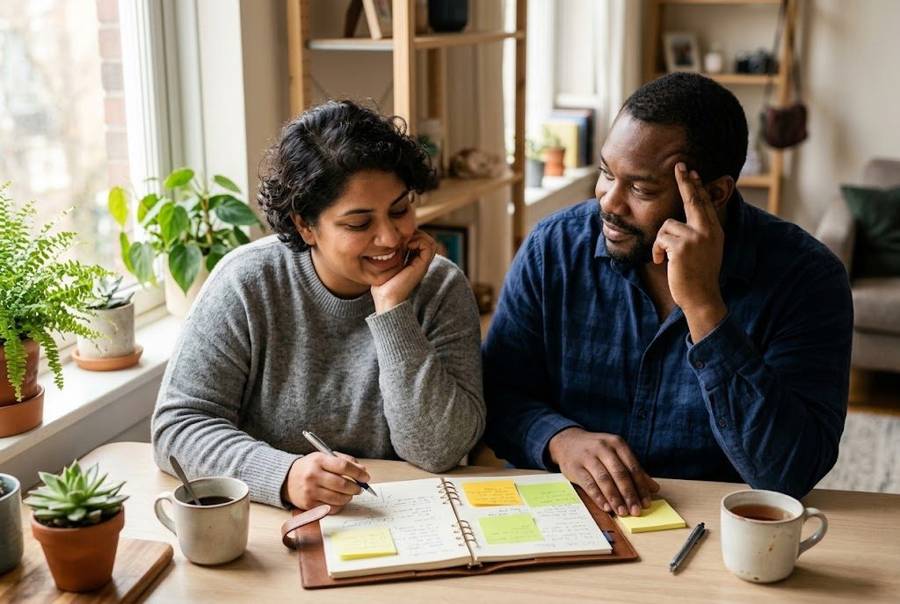
Start with What Matters to Both of You
Planning a wedding involves hundreds of decisions. Some will be easy. Others may reveal that you and your partner have different priorities, expectations, or ideas about what your wedding should be.
Before getting caught up in venues, guest lists, traditions, and all the details, talk about what matters most to each of you. What do you want your wedding to feel like? What are your priorities? Where are you willing to compromise?
Separating your needs from your wants can also help. You may discover that something one of you considers essential matters very little to the other—or that you both care deeply about something you hadn’t discussed.
As you plan, you’ll probably hear plenty of advice from family, friends, members of the wedding party and others. Listen to ideas that may be helpful, but remember that the two of you are planning your wedding.
And keep the larger perspective in mind:
Your wedding is one day. Your marriage is for a lifetime.
Learning to listen to one another, work through differences, and make decisions together may ultimately be one of the most valuable parts of planning your wedding.
5 Questions to Ask Before Making Wedding Decisions
Before making individual decisions about your wedding, it helps to agree on the bigger picture. These five questions can help you identify what matters most to both of you.
1. What would your ideal wedding look and feel like?
For a moment, forget about cost and logistics. What kind of wedding would each of you choose? You may discover that your ideas are very similar—or that you’re starting from very different places.
2. What can you comfortably afford?
Once you’ve talked about what you would love to have, bring the budget into the conversation. Decide where you’re willing to spend more and where you’re comfortable spending less.
Remember that saying yes to one thing often means saying no to something else. That’s not necessarily a sacrifice. It’s how priorities become decisions.
3. What matters most to each of you?
Listen carefully to what your partner values, even when it isn’t particularly important to you. Something that seems like a small detail to one person may have considerable meaning to the other.
You don’t have to want exactly the same things. The goal is to understand what matters to each of you and find a way forward that respects both perspectives.
4. Is the cost worth it to you?
The most expensive choice isn’t necessarily the one that will make your wedding more meaningful or memorable. Ask yourselves whether spending more on a particular element will genuinely add something you value.
Sometimes the answer will be yes. Sometimes you’ll decide the money would be better spent somewhere else—or not spent at all.
5. What are you trying to create?
Think beyond individual details and consider the experience as a whole. Do you want your wedding to feel intimate and relaxed? Elegant and traditional? Simple? Festive? Romantic? Something entirely your own?
When you know what you’re trying to create, many of the smaller decisions become easier.
Making Decisions When You Don’t Agree
You won’t necessarily agree on every wedding decision. When you don’t, resist the temptation to determine whose idea is “right.”
Instead, ask why the choice matters to each of you. Sometimes understanding the reason behind a preference makes the solution much easier to see.
Give yourselves permission to take some time, too. Not every decision has to be made during the conversation in which it first comes up.
Planning a wedding gives you many opportunities to listen, compromise, establish priorities, and solve problems together. The goal isn’t for one person to win. It’s to arrive at a decision you can both live with—and hopefully both feel good about.
Two perspectives can come together and move forward in the same direction.
Continue with communicating about your wedding plans, or return to the step-by-step wedding planning guide.